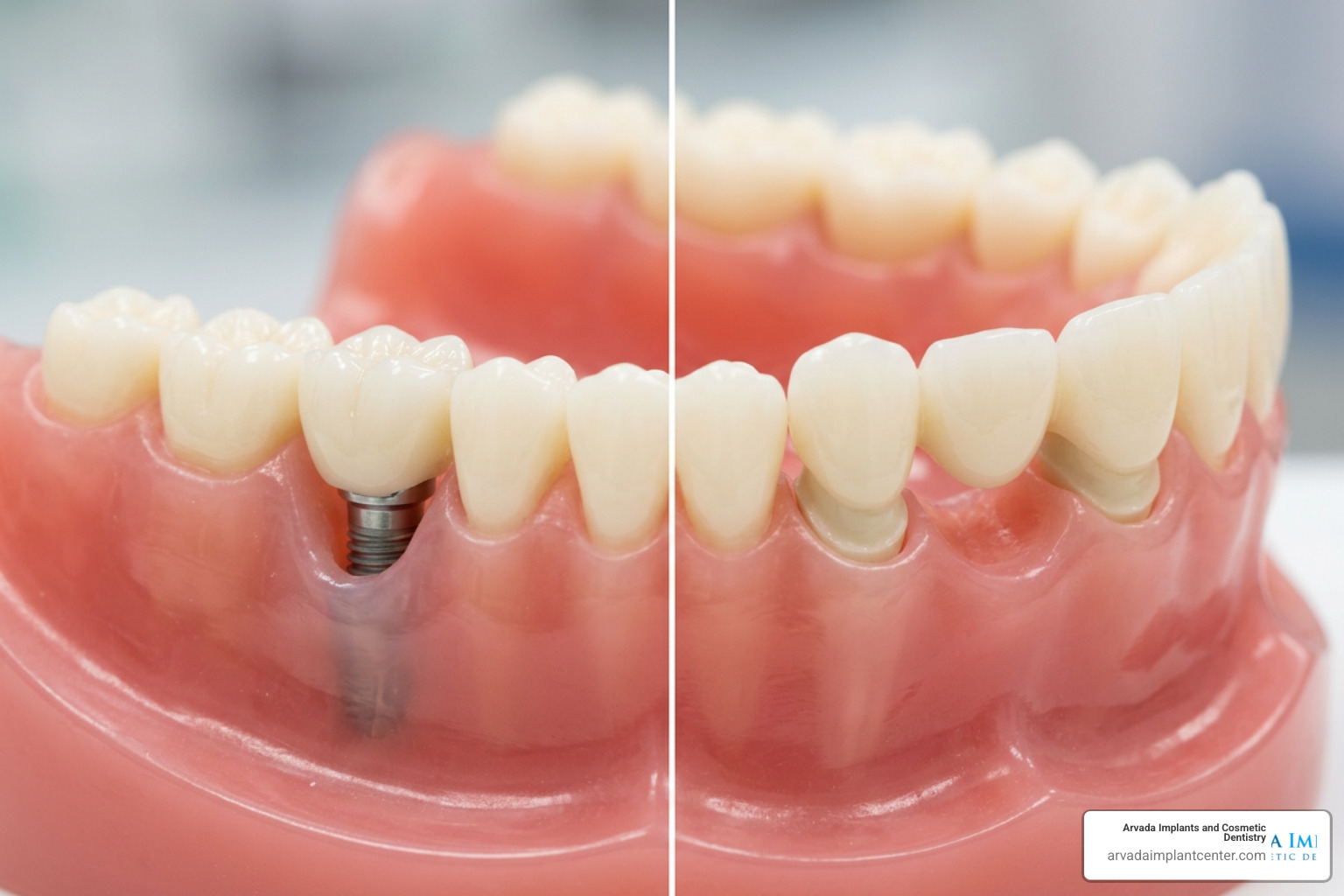
Dental Implant vs. Bridge: Pros, Cons, and Which to Choose
Missing a Tooth? Here's What You Need to Know Before You Decide
When weighing a dental bridge vs implant, most people want one thing: the clearest, fastest answer on which option is right for them.
Here's a quick side-by-side to help you decide at a glance:
Factor Dental Bridge Dental Implant How it works Artificial tooth anchored to adjacent teeth with crowns Titanium post placed in jawbone, topped with a crown Surgery required No Yes Lifespan 10–15 years 25+ years, often lifetime Upfront cost $2,500–$5,000 $3,000–$5,000+ Preserves jawbone No Yes Affects adjacent teeth Yes — healthy teeth must be shaved down No Treatment time 2–3 weeks 3–9 months Insurance coverage More commonly covered Coverage expanding but varies
Bottom line: If you want a faster, lower-cost fix and your neighboring teeth already need crowns, a bridge can make sense. If you want the longest-lasting solution that protects your jawbone and leaves healthy teeth untouched, an implant is usually the better investment.
Tooth loss is more common than most people realize. About 69% of adults between 35 and 44 have lost at least one permanent tooth — and by age 74, roughly one in four Americans has lost all of their teeth. Leaving a gap untreated isn't just a cosmetic issue. Within months, neighboring teeth begin to drift, the opposing tooth starts to over-erupt, and the jawbone beneath the gap begins to shrink. The longer you wait, the more complex — and expensive — the fix becomes.
Choosing between a dental bridge and an implant is one of the most important decisions you'll make for your long-term oral health. The right choice depends on your budget, your health, your timeline, and the condition of the teeth around the gap.
I'm Dr. Tariq Sawaqed, CEO and lead implant dentist at Arvada Implants and Cosmetic Dentistry, with over 20 years of experience helping patients navigate the exact dental bridge vs implant decision you're facing right now. In this guide, I'll walk you through everything you need to make a confident, informed choice.
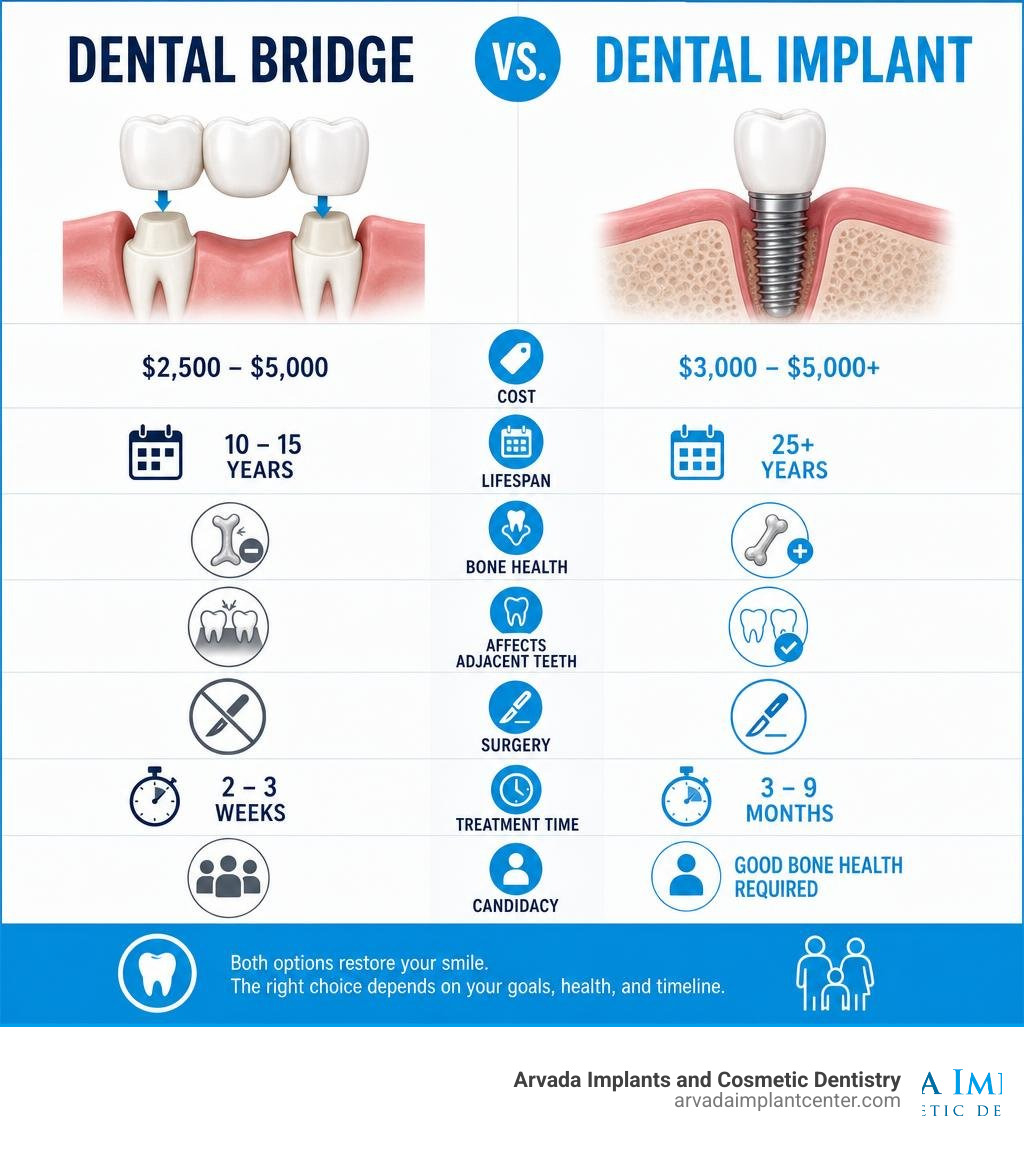
Dental Bridge vs Implant: Key Differences and Structural Comparison
To understand which option fits your mouth best, we must first look at how these two restorations are built from the ground up. They solve the same basic problem — filling an empty space — but they do so using completely different structural philosophies.
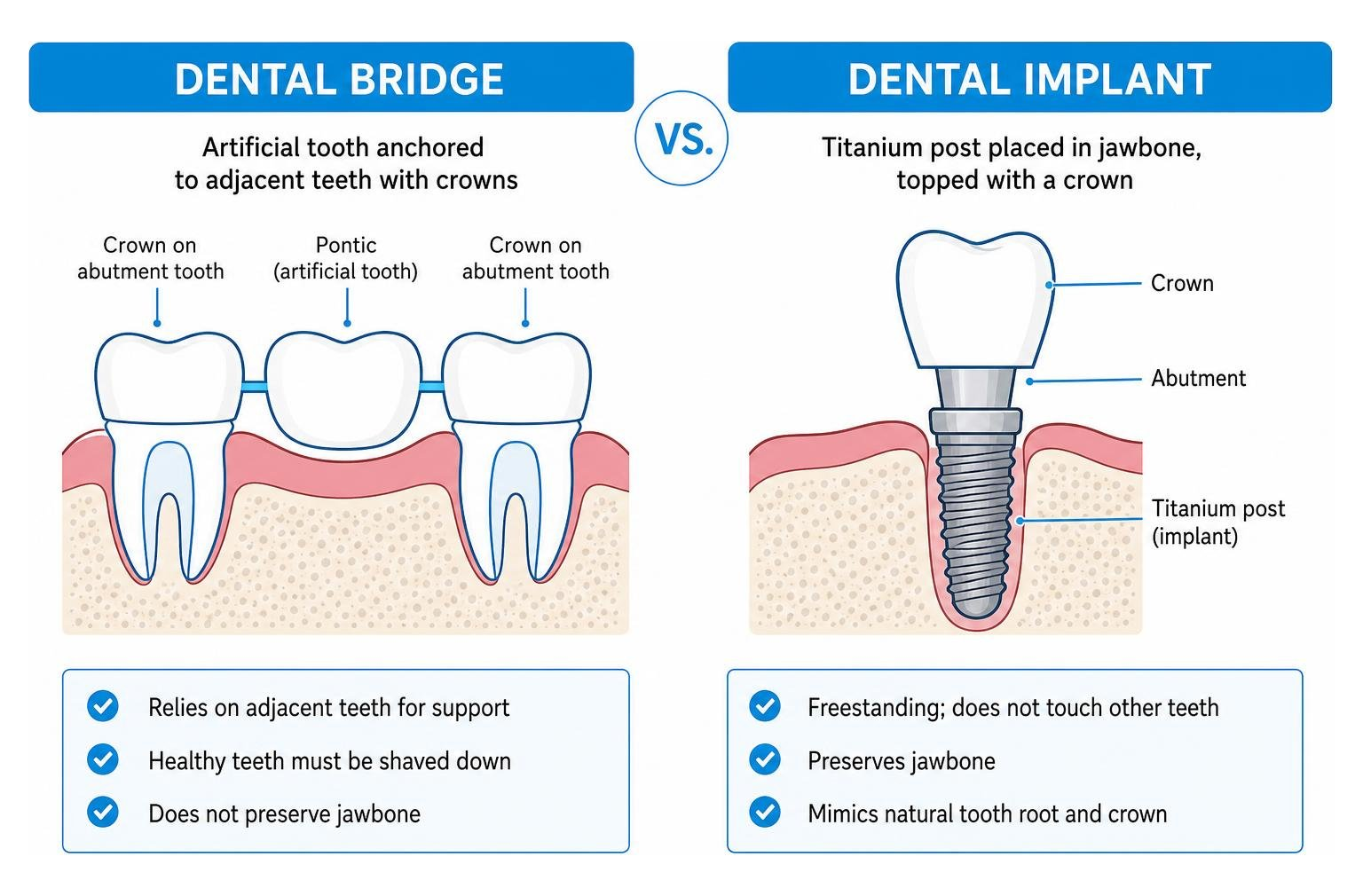
A traditional dental bridge is a single, connected prosthetic that literally "bridges" the gap left by a missing tooth. It relies on the teeth on either side of the empty space (known as abutment teeth) for physical support. To place a bridge, we must permanently shave down the healthy enamel of these neighboring teeth and cover them with dental crowns. Suspended between these two crowns is the "pontic," which is the custom-crafted artificial tooth that sits flush against your gums.
In contrast, a dental implant is a completely freestanding restoration. It does not rely on, touch, or alter your surrounding teeth. Instead, it mimics the natural anatomy of a tooth from root to crown. An implant consists of three parts:
The Titanium Post: A small, biocompatible screw that we surgically place directly into your jawbone. This acts as your new, artificial tooth root.
The Abutment: A small connector piece that screws into the titanium post and sits just above the gumline.
The Crown: A beautiful, custom-milled porcelain or zirconia tooth that attaches to the abutment, completing your smile.
To help you visualize how these differences impact your daily life and long-term oral health, let's break down the primary structural characteristics side-by-side:
Feature Dental Bridge Dental Implant Structural Support Relies entirely on neighboring teeth Relies entirely on the jawbone Impact on Healthy Teeth Requires shaving down adjacent enamel Leaves adjacent teeth completely untouched Cavity Risk High risk of decay at crown margins 100% cavity-proof materials Chewing Force Restores roughly 60% to 80% Restores up to 90% to 100% Bone Preservation None (bone beneath pontic resorbs) Stimulates and preserves bone density
If you are looking to replace a tooth, understanding these structural baselines is the first step toward making an informed choice. You can read more about how we approach these restorations on our tooth replacement options page. For additional clinical perspectives on how these structures differ, you can also explore the Cleveland Clinic Insights on Dental Bridge vs Implant.
Pros, Cons, and Biological Impacts of Each Option
Choosing between a dental bridge vs implant is not just a cosmetic or financial decision; it is a biological one. Your teeth, gums, and jawbone exist in a delicate, interactive ecosystem. When you lose even a single tooth, that ecosystem is thrown out of balance, and how you choose to replace it will alter the future of your mouth.
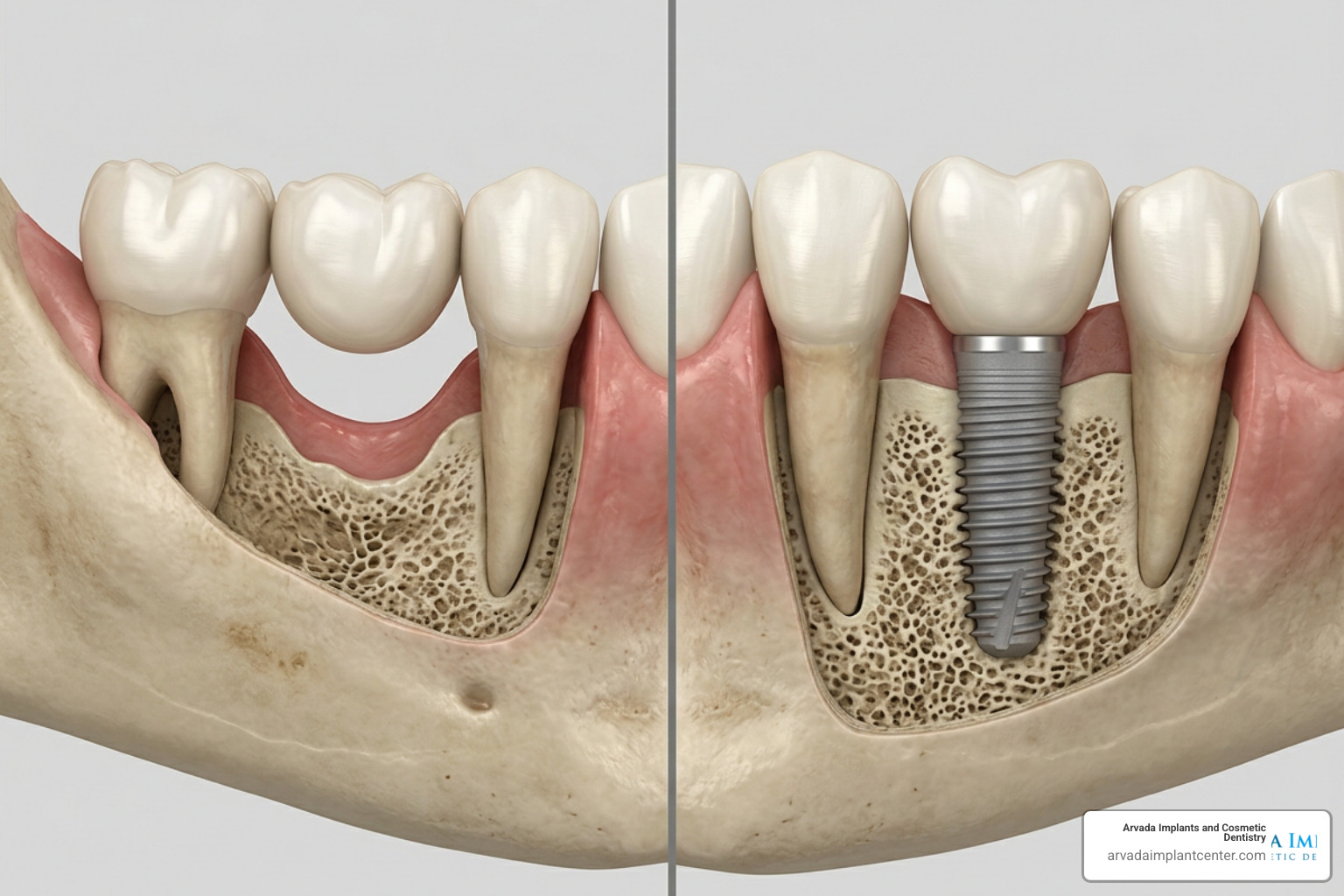
The most significant biological factor to consider is what we call the "bone factor." Your jawbone requires constant mechanical stimulation to maintain its volume and density. This stimulation comes from the physical pressure of chewing, which travels down your natural tooth roots into the bone.
When a tooth is lost, that stimulation vanishes. The bone in the empty space begins to resorb (shrink) almost immediately. In fact, peer-reviewed clinical studies show that the bone in a missing tooth gap can lose up to 50% of its horizontal ridge width within the first 12 months alone.
Because a dental bridge simply sits on top of the gum tissue, it provides zero stimulation to the underlying bone. Over the course of 5 to 10 years, the bone beneath the bridge's pontic will slowly melt away. This resorption often leads to a visible gumline dip, gum recession, and an unsightly gap under the bridge where food particles easily collect.
Dental implants completely prevent this biological decline. Because the titanium post fuses directly with your living jawbone through a process called osseointegration, it transmits chewing forces directly into the bone. This active stimulation preserves your jaw's structural integrity, maintains your natural facial shape, and prevents the premature aging associated with bone loss.
Furthermore, a dental bridge converts a single-tooth issue into a multi-tooth issue. If one of the supporting anchor teeth develops a cavity under the crown margin or suffers structural damage, the entire bridge fails. This can lead to a "bridge failure cascade," where you eventually lose the supporting teeth as well, requiring a much larger, more expensive restoration down the road. Because implants are freestanding, they eliminate this risk entirely.
Understanding the Dental Bridge vs Implant Longevity and Durability
When evaluating the long-term value of your investment, durability is a massive piece of the puzzle. How long can you realistically expect each restoration to last before it needs to be repaired or completely remade?
Clinical data shows a stark contrast between the two:
Dental Bridges: On average, a traditional dental bridge has a lifespan of 10 to 15 years before it requires a remake. While some can last longer with meticulous care, the American Dental Association notes that many bridges need to be replaced every 5 to 7 years due to decay forming at the margins of the supporting crowns or structural wear.
Dental Implants: When properly cared for, a dental implant post can last a lifetime. The titanium screw becomes a permanent part of your anatomy. The custom porcelain or zirconia crown attached to the top is subject to normal biting wear and tear, but typically lasts 15 years or more before needing a simple replacement, leaving the underlying implant post completely undisturbed.
In terms of clinical predictability, dental implants boast a highly documented 10-year success rate of approximately 97% in peer-reviewed studies. On the other hand, traditional three-unit dental bridges carry a 15-year success rate of roughly 90%. Over a 20-year horizon, a bridge will almost certainly need to be replaced at least once, whereas an implant remains structurally sound.
To explore more about this long-term outlook, you can read the Rodin Dental Office Tokyo Insights on Longevity or take a deeper look at our advanced implant techniques by visiting our page on how we design our dental implants.
How a Dental Bridge vs Implant Affects Your Surrounding Teeth and Jawbone
The long-term health of your surrounding "virgin" teeth (teeth that have never had cavities or crowns) should be a primary deciding factor.
To prepare anchor teeth for a bridge, a dentist must permanently grind down their enamel. Once healthy enamel is removed, it can never grow back. This process weakens the structural integrity of those adjacent teeth and can occasionally irritate the inner dental pulp, leading to the need for a root canal. If those adjacent teeth are already perfectly healthy and beautiful, altering them to support a bridge is a significant biological compromise.
Additionally, because a bridge connects three or more teeth together with no physical spaces between them, you can no longer floss normally. You must use specialized cleaning tools, such as floss threaders or interdental brushes, to clean beneath the pontic. If your home care slips, plaque will quickly accumulate at the crown margins, leading to decay.
Implants, however, allow you to brush and floss exactly like a natural tooth. There are no connected parts to trap food, and the materials used in implants are completely impervious to cavities. To learn more about how we protect your adjacent teeth with custom crown and bridge work, check out our guide to crowns and bridges.
Financial Breakdown: Upfront Costs vs. Long-Term Value
Let's address the question that keeps many patients up at midnight: How much is this going to cost, and which option is actually cheaper over my lifetime?
At first glance, a dental bridge appears to be the more budget-friendly choice. However, when you look at a 20-year "total cost of ownership," the math often flips in favor of the implant.
The Upfront Cost of a Bridge: A traditional three-unit dental bridge typically ranges from $2,500 to $5,000 depending on the materials used (such as porcelain-fused-to-metal or high-end zirconia) and the complexity of the case.
The Upfront Cost of an Implant: A single dental implant in the United States typically ranges from $3,000 to $5,000+ (which includes the surgical placement of the post, the abutment, and the custom crown).
While the upfront cost of an implant is higher, consider the long-term replacement math. If you get a bridge at age 45, you will likely need to replace it at least once, if not twice, by the time you reach retirement. Replacing a bridge means paying for the entire multi-unit prosthetic all over again. If a supporting tooth has decayed, you may also face the cost of root canals, extractions, or a larger bridge.
An implant, conversely, is a one-and-done investment for most patients. Over 20 years, the cost-per-year of a dental implant is significantly lower than that of a bridge.
When it comes to dental insurance, bridges are historically more likely to be covered as a standard "major restoration," with insurance plans paying up to 50% of the cost after your deductible. While implant coverage was once rare, many modern dental plans in 2026 are expanding their benefits to include implants because they recognize their long-term health advantages.
To help make your treatment highly manageable, we can often utilize a "two-calendar-year strategy." By placing the implant post in December (using your current year's insurance maximum) and fabricating the final custom crown in January (utilizing the following year's maximum), we can significantly reduce your out-of-pocket expenses.
To get a precise, localized estimate on your treatment costs, you can read our detailed breakdown on the cost of one dental implant or explore our flexible insurance and finance options.
Treatment Timelines, Candidacy, and Alternatives
The journey to a restored smile looks very different depending on which path you choose.
A dental bridge is a sprint. The entire process can usually be completed in just two visits over a 2-to-3-week period. During your first visit, we prepare the anchor teeth, take highly accurate digital impressions, and place a comfortable temporary bridge. Once our custom lab finishes crafting your permanent bridge, you return to our Arvada office to have it permanently cemented in place.
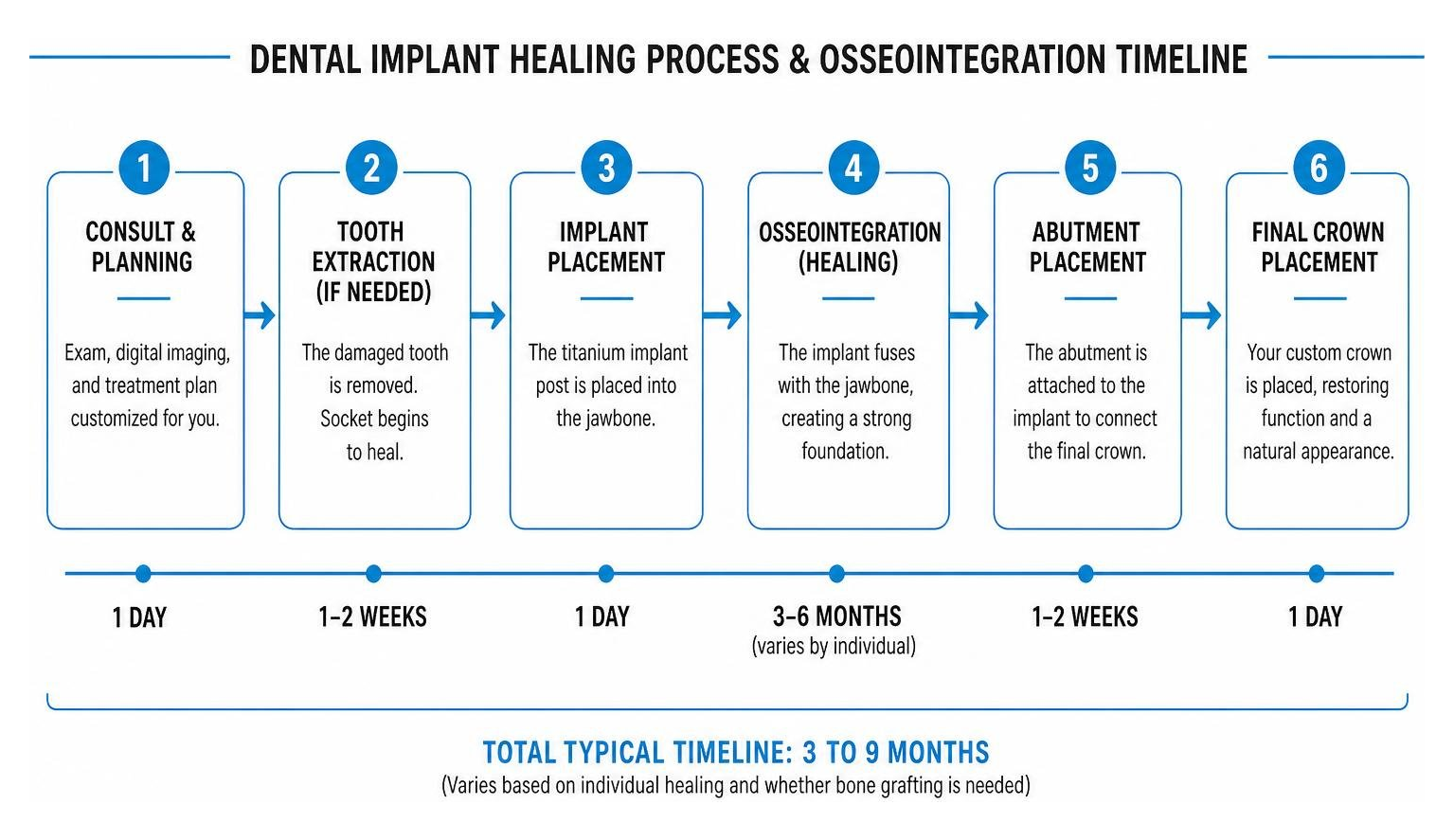
An implant, on the other hand, is a marathon. The traditional implant timeline typically spans 3 to 9 months to allow for proper healing and bone integration:
Preparation and Grafting (If Needed): If you have been missing the tooth for a long time, we may need to perform a bone graft to rebuild the foundation. This adds 3 to 6 months of healing time.
Implant Placement: We surgically insert the titanium post into your jawbone.
Osseointegration (3 to 6 Months): We wait for your jawbone to naturally grow around and fuse with the titanium post. During this time, we can provide a comfortable temporary replacement tooth so you never have to go without a smile.
Abutment and Crown Placement: Once fully integrated, we attach the connector and your final, custom-milled crown.
Modern digital workflows and advanced protocols, such as immediate-load implants, are rapidly narrowing this timeline gap. In select cases with excellent bone density, we can place the implant post and attach a temporary crown on the very same day as your extraction.
To learn more about what to expect during this journey, read our guides on the dental implant process step by step and the dental implant recovery timeline.
Who is a Good Candidate for a Dental Bridge?
A dental bridge may be the superior clinical recommendation for you if:
Your adjacent teeth already need work: If the teeth on either side of the empty space already have large, failing fillings, cracks, or decay, crowning them to support a bridge solves two problems at once.
You have severe bone loss: If you lack the bone density required for an implant and wish to avoid the cost or surgery of a bone graft.
Your medical history contraindicates surgery: Patients with uncontrolled systemic diseases (like severe diabetes or leukemia) or those taking bone-modifying medications (like bisphosphonates for osteoporosis) may heal poorly from surgery, making a non-invasive bridge the safer option.
You need a rapid solution: If you have a major life event, such as a wedding or a job transition, in the next few weeks.
Who is a Better Candidate for a Dental Implant?
You are likely an ideal candidate for a dental implant if:
Your adjacent teeth are healthy and untouched: If your neighboring teeth are perfectly healthy ("virgin" teeth), we want to avoid grinding down their enamel at all costs.
You have adequate jawbone density: Or you are willing to undergo a minor bone grafting procedure to build a rock-solid foundation.
You prioritize long-term health and value: You want a permanent, cavity-proof solution that preserves your youthful facial structure.
You are over the age of 18: Implants should only be placed once jaw growth is fully complete.
If you are preparing for this step, you can learn more about how we evaluate your mouth on our dental implant preparation page.
Removable Alternatives: Dentures vs. Fixed Restorations
If you are not quite ready to commit to a fixed bridge or an implant, there are temporary or removable alternatives available:
Removable Partial Dentures: These are acrylic or metal-framed appliances that clip onto your remaining natural teeth. While they are the most affordable upfront option, they only restore about 25% to 40% of your natural chewing power, can slip while speaking, and do not stop bone loss.
Space Maintainers: Often used as a temporary placeholder to keep adjacent teeth from shifting while you save up for a permanent implant.
To compare these options in greater detail, you can read our comprehensive guide on dentures vs implants.
Frequently Asked Questions About Tooth Replacement
Can a dental bridge be replaced with an implant later?
Yes, absolutely. If you currently have an aging dental bridge that is starting to fail, we can safely transition you to a dental implant. When we remove the old bridge, we will evaluate the health of the supporting teeth. Because bone naturally resorbs under a bridge pontic over the years, we will likely need to perform a localized bone graft to rebuild the ridge before placing your new implant post. Once healed, we will place the implant and place individual, beautiful crowns on the adjacent teeth to restore their natural appearance.
Is dental implant surgery painful compared to getting a bridge?
Most patients are pleasantly surprised by how comfortable the implant procedure actually is. The surgery is performed under local anesthesia, meaning you will feel some pressure but absolutely no sharp pain. Many patients report that getting an implant is actually easier and less uncomfortable than a standard tooth extraction. Any post-operative soreness is easily managed with over-the-counter pain relievers like ibuprofen for 2 to 3 days. Getting a bridge does not require surgery, but the extensive grinding of adjacent teeth can sometimes cause temporary temperature sensitivity.
Does dental insurance cover implants or bridges?
Yes, most dental insurance plans cover both treatments, but to varying degrees. Traditional bridges are usually classified as a standard "major restorative" procedure and are typically covered at 50% up to your plan's annual maximum limit. Dental implants are increasingly covered by major insurance providers, though some older plans still categorize them as cosmetic or elective. Our experienced financial coordinators in Arvada are experts at navigating insurance benefits and will help you maximize your coverage, including utilizing strategic multi-year planning to minimize your out-of-pocket costs.
Conclusion
At Arvada Implants and Cosmetic Dentistry, we believe there is no "one-size-fits-all" answer when choosing between a dental bridge vs implant. The ideal choice is the one that aligns perfectly with your biology, your lifestyle, your budget, and your long-term goals for your smile.
Our ultimate goal is to provide affordable, highly personalized treatments. Because we utilize our own custom lab creations, we can craft unique, stunning restorations that match the exact shape, translucency, and shade of your natural teeth. Whether you choose a state-of-the-art zirconia bridge or a lifetime dental implant, we are committed to delivering a comfortable, judgment-free experience right here in Arvada, CO.
Ready to take the next step toward reclaiming your smile and your confidence? Schedule a cosmetic dentistry consultation in Arvada with our expert team today!