Veneers vs. Crowns: What Are the Pros and Cons of Each?
Key Structural Differences: Porcelain Crown vs Veneer
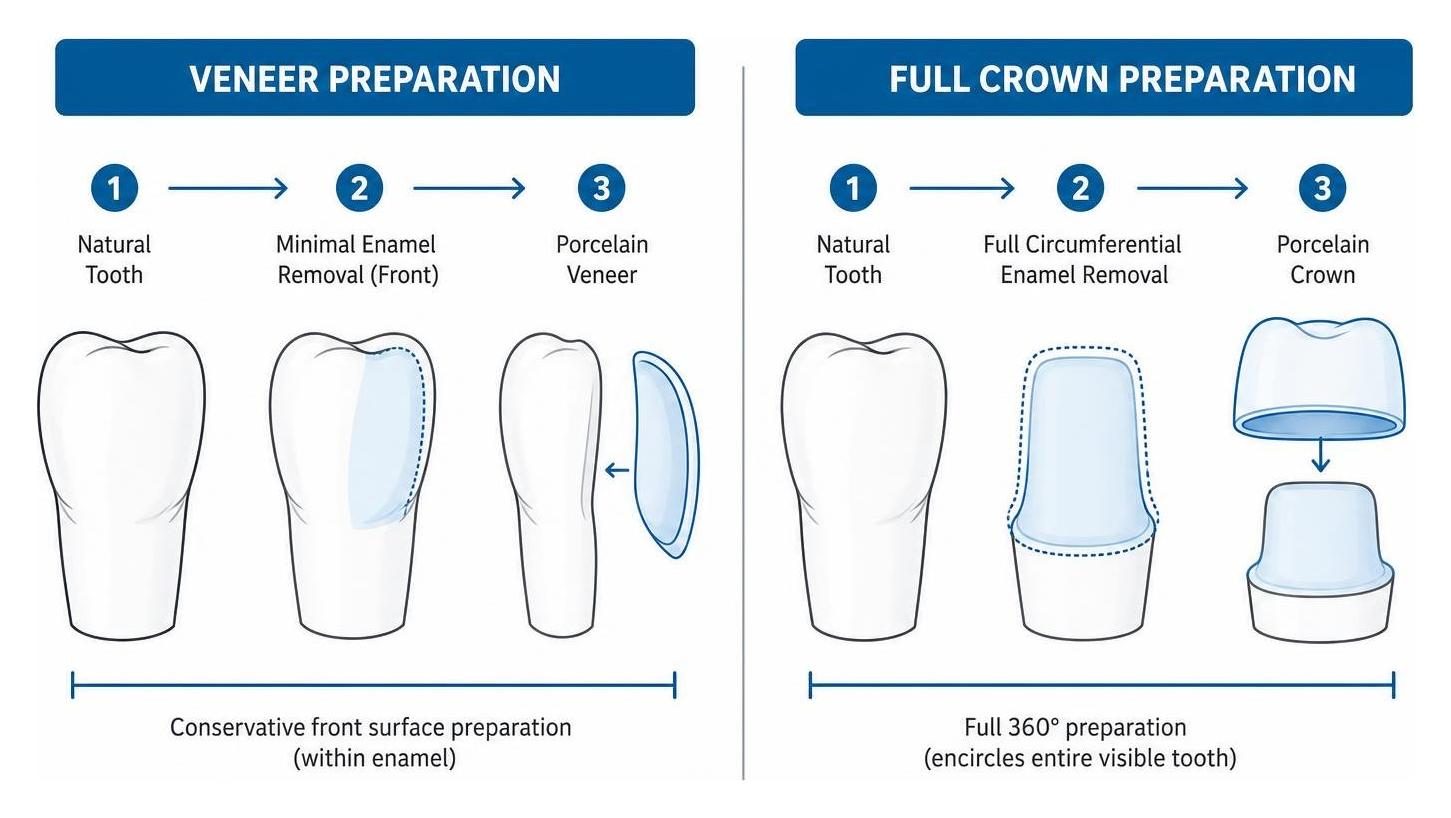
Understanding the fundamental mechanics of a porcelain crown vs veneer starts with how each restoration bonds to your natural tooth. While both match the color and translucency of surrounding enamel, their structural engineering serves entirely different purposes.
A veneer is a thin ceramic shell engineered to adhere to the facial (front) surface of a tooth. According to dental literature detailed on Wikipedia), a veneer functions as a ultra-thin restorative layer designed to alter shade, alignment, or shape while relying heavily on underlying natural enamel for structural integrity. Think of it as a custom-fitted acrylic fingernail, but made of high-strength medical ceramic. It relies heavily on natural tooth enamel for micromechanical bonding and support. In contrast, a crown is a full 360-degree helmet that completely encompasses the visible portion of the tooth above the gumline.
Enamel Preparation for Veneers
To place a porcelain veneer, a dentist carefully removes a razor-thin layer of enamel—typically 0.3 to 0.5 mm—from the front of the tooth. This conservative depth preservation keeps the preparation strictly within the enamel layer, which provides the strongest adhesive bond when paired with specialized resin cements.
Because we keep the majority of the underlying tooth structure intact, getting custom veneers remains one of the least invasive cosmetic options available today. Maintaining that solid enamel foundation helps ensure your restoration stays firmly bonded for years without flexing or debonding under routine bite forces.
Tooth Reduction for Full Coverage Crowns
Preparing a tooth for a full crown requires a bit more preparation and a larger reduction of natural tooth structure. To ensure the final ceramic cap is sufficiently thick to withstand heavy chewing forces without snapping or fracturing, we trim 1.5 to 2.0 mm of tooth structure uniformly from all sides.
This circumferential trimming involves removing 1.5 to 2.0 mm from the biting edge, front, back, and sides of the tooth. While this reduction process is irreversible, placing full-coverage Crowns Bridges provides essential structural reinforcement and structural stability for teeth that are severely compromised, cracked, or extensively decayed.
Clinical Applications and Treatment Suitability
Choosing between a porcelain crown vs veneer is rarely a matter of personal preference; it comes down to clinical health, remaining tooth structure, and long-term functional integrity.
Clinical Condition Recommended Restoration Primary Clinical Reason Minor chips or cosmetic wear Porcelain Veneer Preserves healthy enamel; purely surface-level fix. Severe intrinsic staining Porcelain Veneer Efficiently masks deep discoloration without heavy prep. Slight spacing or minor misalignment Porcelain Veneer Corrects aesthetic alignment conservatively. Extensive decay or large fillings Full Porcelain Crown Rebuilds missing structural integrity on all sides. Root-canal-treated tooth Full Porcelain Crown Protects brittle tooth structure against bite fractures. Deep structural cracks extending to dentin Full Porcelain Crown Holds the remaining tooth together under chewing pressure.
Porcelain Crown vs Veneer: Primary Clinical Indications
If your teeth are fundamentally healthy, strong, and decay-free, veneers are usually the top pick. They excel at transforming aesthetic concerns in the "smile zone"—the front teeth that show when you laugh, speak, or smile.
Within modern cosmetic dentistry, veneers are used to solve:
Persistent staining or deep intrinsic discoloration that resists professional whitening treatments
Minor gaps, uneven spacing, or slightly crooked front teeth
Superficial chips, surface wear, enamel erosion, or minor shape irregularities
Restoring Compromised and Root-Canal-Treated Teeth
When a tooth loses over half of its original tooth structure to decay, trauma, or large repeated fillings, a veneer simply won't have enough surface area or support to bond securely. Under intense lateral or vertical biting pressure, an unsupported veneer on a severely damaged tooth will flex and fail.
Furthermore, teeth that have undergone root canal therapy lose their internal vascular supply and natural moisture, making them naturally brittle and vulnerable to shear forces over time. A full-coverage crown acts as a protective shield, locking the remaining tooth structure together to prevent catastrophic vertical root fractures. If a tooth is damaged beyond what even a crown can save, options like Dental Implants may be discussed to replace the missing tooth completely and restore full oral function.
Longevity, Durability, and Gum Interaction
Both restorations offer exceptional longevity, but their overall lifespan depends on high-quality materials, precise laboratory fabrication, solid oral hygiene, and healthy gum tissue.
Long-Term Longevity: Porcelain Crown vs Veneer Lifespan
Clinical studies indexed on PubMed show that porcelain laminate veneers boast a 10-year cumulative survival rate of over 95%. High-strength lithium disilicate (E-max) veneers achieve a 10-year survival rate of around 97.4%. All-ceramic E-max and zirconia crowns show comparable survival rates of roughly 95% over a decade.
While crowns are physically thicker (around 1.5 to 2.0 mm) and can take heavy chewing loads in the molar regions, veneers (at roughly 0.3 to 0.7 mm thick) gain incredible strength once chemically fused to healthy enamel via resin bonding agents. However, if you grind or clench your teeth at night (bruxism), wearing a custom night guard is essential to protect both types of restorations from edge chipping or shear stress fractures.
Periodontal Margins and Gum Tissue Health
How your restoration meets your gumline plays a huge role in long-term periodontal health and aesthetic stability. Veneer margins are usually kept "supragingival" (at or slightly above the gumline), making them exceptionally periodontally friendly. Keeping the margin above the gums makes daily flossing easy, minimizes plaque accumulation, and prevents localized tissue inflammation.
Crown margins, on the other hand, are sometimes placed "subgingival" (slightly below the gumline) to hide the transition between ceramic and natural tooth structure or to cover deep areas of decay. If the margin invades the delicate tissue barrier known as the biological width (the approximately 2 mm junctional attachment of the gums), it can cause localized inflammation, chronic bleeding, or gum recession over time.
Cost, Insurance, and Financial Planning
When evaluating the cost of a porcelain crown vs veneer, keep in mind that initial prices reflect differences in laboratory fabrication, clinical prep time, material complexity, and insurance coverage eligibility.

In the United States, porcelain veneers typically range from $925 to $2,500 per tooth. Because veneers are classified as elective cosmetic procedures intended solely to enhance appearance, standard dental insurance policies almost never cover their cost.
Porcelain crowns range from $1,000 to $3,500 per tooth. However, because crowns are utilized to restore structurally damaged, cracked, or severely decayed teeth, dental insurance plans often cover 40% to 50% of the procedure cost when deemed medically necessary by clinical x-rays and diagnostic examination.
At Arvada Implants and Cosmetic Dentistry, we believe high-quality dental care should be accessible and transparent. We encourage patients to review our Insurance And Finance policies and explore our flexible Payment Plans to help manage out-of-pocket costs smoothly and comfortably.
Frequently Asked Questions about Crowns and Veneers
Can a veneer be placed on a root-treated tooth or large filling?
Generally, no. A tooth that has underwent root canal treatment or holds a massive filling lacks the structural strength and intact enamel surface required to properly support a veneer. Root-treated teeth become brittle over time and require the 360-degree circumferential reinforcement of a full-coverage crown (often built over a supportive core buildup) to keep the tooth from breaking under heavy biting loads.
Can you switch from a veneer to a crown later in life?
Yes, you can easily transition from a veneer to a crown if clinical needs change. If a veneered tooth experiences localized decay, structural wear, or gum recession later in life, your dentist can safely remove the existing veneer, prepare the remaining circumference of the tooth, and place a custom full coverage crown.
However, you cannot transition from a crown back to a veneer. Because full crown preparation permanently removes outer enamel on all sides of the tooth, that tooth will always require a full 360-degree crown restoration.
What questions should I ask my dentist before choosing?
Before committing to treatment, it's a great idea to discuss these key questions during your consultation:
Does my underlying tooth have enough healthy enamel to support a long-lasting veneer?
Do you use conservative depth-cutting burs to preserve as much natural tooth structure as possible?
Do you work with custom dental laboratories to match the shade, texture, and translucency of my adjacent natural teeth?
Will my specific bite pattern or nocturnal clenching require a custom night guard to protect my investment?
What portion of this procedure will my dental insurance cover, and what pre-authorizations are needed?
Conclusion
Choosing between a porcelain crown vs veneer isn't about which restoration is inherently "better"—it's about which precise clinical approach is right for your unique smile goals and oral health status. Veneers offer a brilliant, conservative way to enhance your appearance while preserving valuable natural enamel. Crowns provide essential strength, stability, and full 360-degree protection to rebuild damaged, decayed, or root-treated teeth.
At Arvada Implants and Cosmetic Dentistry, we pride ourselves on providing personalized treatment plans tailored specifically to your clinical needs and budget. Ready to discover the best path forward for your smile? Meet Dr Arlet and our experienced team, explore our transformative cosmetic results in our smile gallery, or Contact Us today to schedule your comprehensive consultation!