How to Get Dental Coverage When You Have Medicare
The Medicare Dental Gap: What Seniors Need to Know About Dentures
Dentures for seniors on Medicare are far more complicated to pay for than most people expect — and the confusion often leads to costly surprises.
Here's the short answer:
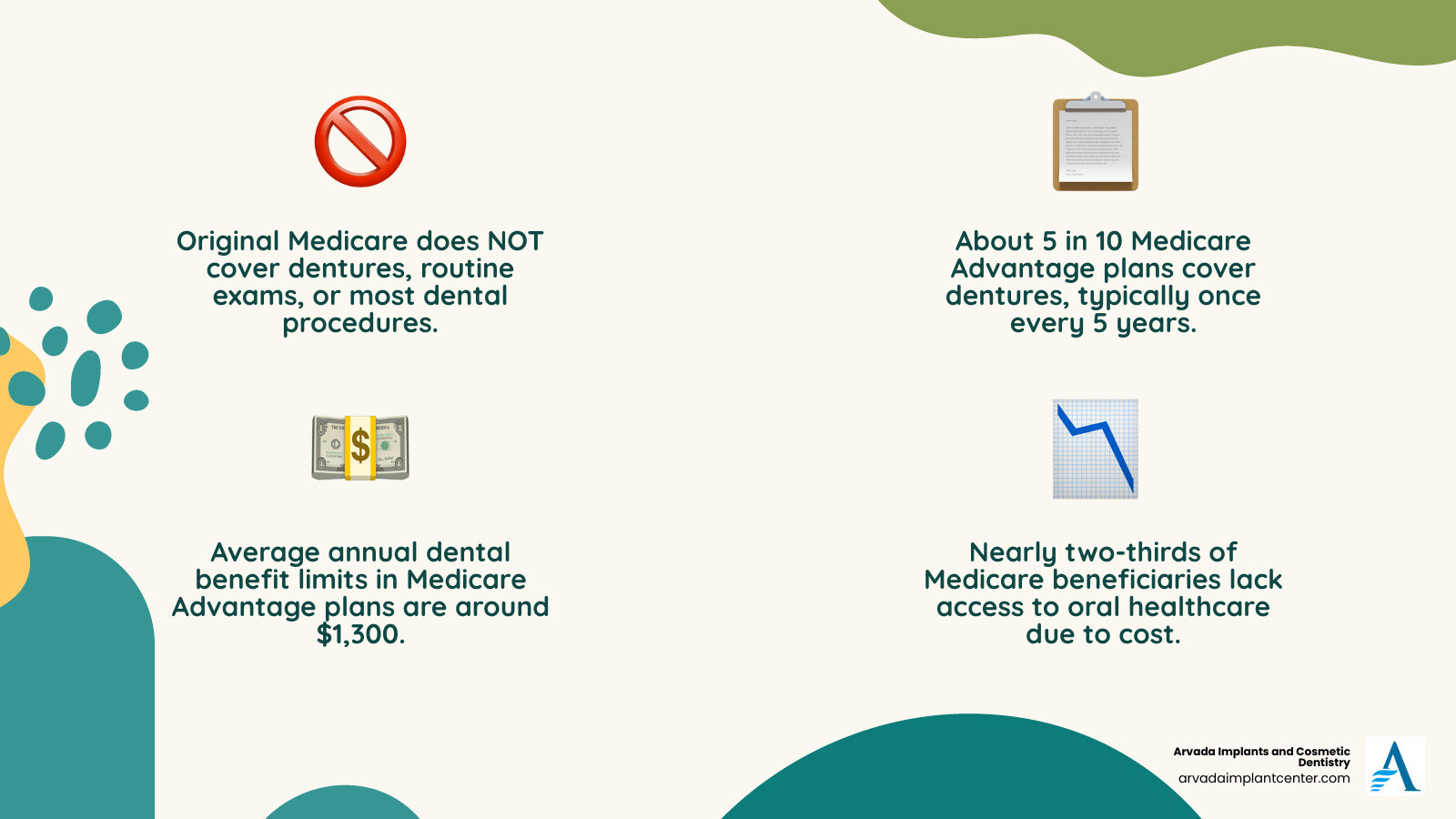
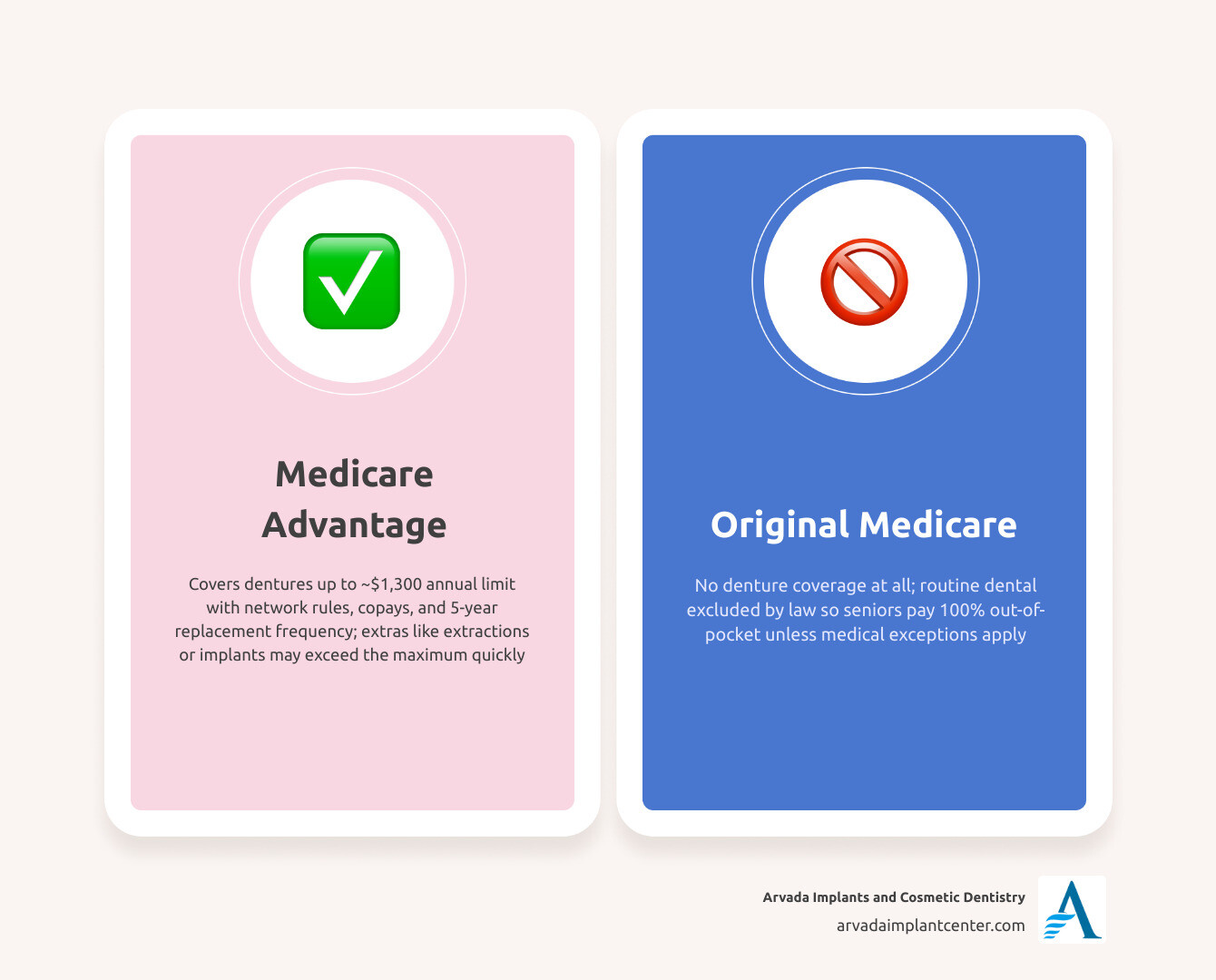
Original Medicare (Parts A and B) does NOT cover dentures, routine dental exams, cleanings, or most dental procedures
Medicare Advantage (Part C) plans may cover dentures, but coverage varies widely by plan
About 5 in 10 Medicare Advantage plans cover dentures, typically limiting coverage to one set every 5 years
Average annual dental benefit limits in Medicare Advantage plans are around $1,300
If your plan doesn't cover dentures, alternatives include standalone dental insurance, dental discount plans, Medicaid, and HSA funds
The numbers tell a stark story. Nearly two-thirds of people with Medicare lack access to oral healthcare. About 14% of adults over 65 have no natural teeth at all. And almost half of Medicare beneficiaries don't visit a dentist in a given year — often because they simply can't afford it.
This is not a small problem. It's a crisis hiding in plain sight.
I'm Dr. Tariq Sawaqed, founder of Arvada Implants and Cosmetic Dentistry, and with over 20 years of clinical experience I've helped hundreds of Colorado seniors navigate the real costs and coverage options for dentures for seniors on Medicare. In the sections ahead, I'll walk you through exactly what Medicare covers, what it doesn't, and how to find the most affordable path to a functional, confident smile.
Does Original Medicare Cover Dentures for Seniors on Medicare?
No. In almost all cases, Original Medicare does not pay for dentures.
That means Medicare Part A and Part B generally do not cover:
Full dentures
Partial dentures
Routine dental exams
Cleanings
Fillings
Crowns
Bridges
Most extractions done as routine dental care
Dental implants
This rule has been part of Medicare for a long time. Under federal law, routine dental care is generally excluded from coverage. If you are enrolled in Original Medicare only, you should expect to pay the full cost of dentures yourself unless you qualify for a very limited medical exception.
For a plain-language overview, see Medicare and dental coverage: options, oral health, options, and costs and the official Medicare page on dental services.

A quick breakdown:
Part A mainly covers inpatient hospital care
Part B mainly covers outpatient medical care and doctor services
Neither part is designed to function like dental insurance
So if you are searching for dentures for seniors on Medicare, the first and most important thing to know is this: Original Medicare is not the denture solution many people assume it is.
Medical Exceptions for Dentures for Seniors on Medicare
There are a few narrow situations where Medicare may cover certain dental-related services, but these are medical exceptions, not routine denture benefits.
Examples include:
Dental care provided during an inpatient hospital stay
Dental services tied to jaw reconstruction after an injury or disease
Oral exams or treatment needed before certain organ transplants
Dental treatment needed to clear infection before cancer treatment
Certain dental services related to Medicare-covered dialysis or ESRD care
The key idea is medical necessity. Medicare may pay when dental treatment is closely linked to the success of a covered medical procedure. It is not paying because dentures or dental care are important on their own, even though they absolutely are.
CMS explains these exceptions in more detail here: Medicare Dental Coverage | CMS.
A few important cautions:
Even if Medicare covers the medical portion, it may not cover the denture itself
Coverage often depends on documentation and coordination between medical and dental providers
Part B-covered dental services can still leave you with 20% coinsurance after the deductible
Part A hospital-related coverage may involve hospital deductibles and cost-sharing
So yes, there are exceptions, but they are narrow enough that we never want patients to assume Medicare will pay unless the case has been verified in writing.
Why Original Medicare Excludes Routine Dentures
Original Medicare dates back to 1965, and routine dental benefits were left out from the start. That gap still affects millions of seniors today.
The result is a system where oral health often gets treated like an optional extra, even though it directly affects:
Nutrition
Speech
Social confidence
Comfort
Overall health
This disconnect helps explain why so many older adults delay care. Research shows:
Nearly two-thirds of people with Medicare lack access to oral healthcare
About 18% of adults age 65 and older have untreated tooth decay
Almost half of Medicare beneficiaries do not see a dentist in a given year
About 14% of adults over 65 have no natural teeth
And when people do get care, the bill can sting. About half of Medicare beneficiaries who received dental care paid an average of $874 out of pocket in 2018, and 20% paid more than $1,000.
That is why planning matters. Dentures are not just a one-time purchase. They often involve exams, impressions, fittings, extractions, relines, adjustments, and eventual replacement. Medicare's routine dental exclusion leaves patients holding the bill for all of it.
Medicare Advantage (Part C) and Denture Benefits
If Original Medicare is the locked door, Medicare Advantage is often the side entrance.
Medicare Advantage plans are offered by private insurers and must provide at least the same core coverage as Original Medicare. Many also add extra benefits, including dental. In fact, the vast majority of Medicare Advantage plans offer some form of dental coverage, but "some form" can mean very different things.

Some plans include only preventive dental, such as:
Exams
Cleanings
X-rays
Other plans include comprehensive dental benefits, which may cover:
Fillings
Crowns
Extractions
Bridges
Dentures
This is where seniors can sometimes find help with dentures for seniors on Medicare. But the details matter more than the marketing.
Before enrolling, we recommend reviewing:
The plan's Summary of Benefits
The Evidence of Coverage
Whether dentures are listed under comprehensive dental or prosthodontic services
Whether your dentist is in-network
Whether preauthorization is required
If you are also budgeting for treatment, our Insurance and Finance page and Payment Plans page can help you understand how to combine insurance benefits with practical financing options.
Costs and Limits for Dentures for Seniors on Medicare
Medicare Advantage denture coverage is helpful, but it is rarely unlimited.
Common plan features include:
Annual dental maximums
Fixed copays
Percentage-based coinsurance
Network restrictions
Frequency limits
Prior authorization rules
The average annual dental benefit limit in Medicare Advantage plans has been around $1,300, according to the research cited above. Some plans offer more, and some offer less. A few plans, especially certain dual-eligible plans, may provide richer benefits, but those depend on eligibility and location.
Typical denture-related cost-sharing may look like this:
$0 to several hundred dollars in copay for dentures
20% to 70% coinsurance for major services
One set of dentures covered every 5 years
Coverage only through in-network dentists
Annual maximum reached quickly if extractions or other major work are also needed
Here is a simple comparison:
Coverage option Dentures covered? Typical monthly cost Annual limit Common catches Original Medicare No Part B premium applies None for dentures Routine dental excluded Medicare Advantage with comprehensive dental Sometimes Varies by plan Often around $1,300 Network, copays, preauth, 5-year rule Standalone dental insurance Sometimes Often about $25-$60 Often $1,000-$2,500 Waiting periods, exclusions Dental discount plan Discounts only Usually lower membership fee No true insurance cap You still pay discounted fees
One practical reality: a denture benefit does not mean the whole treatment is covered. If you need extractions, bone smoothing, temporary dentures, relines, or implant support, your total cost may still exceed the plan maximum quickly. Think of the annual allowance like a coupon, not a magic wand.
Finding the Right Medicare Advantage Plan
If you are shopping for a plan in Colorado, do not stop at "includes dental." That phrase is too vague to trust on its own.
Instead, look for answers to these questions:
Does the plan cover comprehensive dental, not just preventive?
Are dentures specifically listed?
Are partial dentures covered as well as full dentures?
Is there a waiting period?
Is preauthorization required?
Does the plan require an in-network provider?
Is there a frequency limit, such as one set every 5 years?
What is the annual maximum?
Does the coverage apply to relines, repairs, or replacements?
Use the Medicare Plan Finder and then verify the plan's Evidence of Coverage before enrolling. If you already have a plan, call the insurer and ask for the exact denture benefit in writing. It is not glamorous, but neither is finding out after treatment that your "coverage" was mostly decorative.
Understanding the Costs and Types of Dentures
Not all dentures are the same, and neither are their prices.
The cost of dentures depends on:
Whether they are full or partial
The materials used
How customized the fit is
Whether extractions are needed
Whether relines or adjustments are included
Whether implants are involved
For general market ranges, traditional removable dentures are often in the range of roughly $1,500 to $3,000 per arch, though lower-cost economy options and higher-end custom options can fall outside that range. Some sources cite bargain dentures starting far lower, while premium custom dentures can cost much more.
At our practice, we focus on personalized treatment and custom lab creations because fit, comfort, and appearance matter. Dentures are not socks. You should not have to "break them in" forever.
Common denture types include:
Full dentures for patients missing all teeth in an arch
Partial dentures for patients missing some teeth
Immediate dentures placed soon after extractions
Conventional dentures made after healing
Flexible partials in some cases
Implant-supported options for greater stability
If you want a deeper dive into treatment choices, explore:
Material choices also matter. Acrylic is common and generally more affordable. Porcelain can offer a more natural tooth appearance in some cases, but it may not be right for every patient. The best option depends on bite forces, comfort, esthetics, weight, and long-term wear.
Advanced Options: Snap-In and Implant-Supported Dentures
Traditional dentures rest on the gums. Implant-supported dentures are anchored more securely using implants placed in the jawbone.
These options can offer:
Better stability
Less slipping while eating or speaking
Better chewing efficiency
Improved confidence
Help reducing bone loss over time compared with conventional removable dentures
Two terms patients often hear are snap-in dentures and full-arch implant systems. These are not interchangeable in every case, and the best choice depends on anatomy, goals, and budget.
Helpful resources include:
Important note for Medicare patients: even if a Medicare Advantage plan covers standard dentures, implant-supported dentures may have different rules or may not be covered at all. Many plans exclude implants or pay only toward the removable prosthesis portion. Always verify before treatment begins.
Maintenance and Long-Term Care
Dentures are not maintenance-free. They need care, and your mouth changes over time.
Common long-term needs include:
Relines as the gums and bone shift
Adjustments for sore spots
Repairs if a denture cracks or breaks
Replacement after years of wear
Professional evaluations to check fit and oral tissue health
Loose dentures are not just annoying. They can cause irritation, affect speech, reduce chewing ability, and make eating corn on the cob feel like a trust fall.
For ongoing care, see:
Many Medicare Advantage plans also apply replacement limits, often one set every 5 years unless there is a qualifying reason for earlier replacement. That means good maintenance is not just smart for comfort. It may also help you stretch your benefits longer.
Alternatives and Financial Assistance for Seniors
If Medicare Advantage is not available to you, or if the benefit is too limited, you still have options.
Standalone dental insurance
Private dental insurance can help pay for dentures, but read the fine print carefully. These plans often have:
Monthly premiums
Annual maximums
Waiting periods for major services
Exclusions for preexisting tooth loss in some policies
Separate benefit levels for preventive, basic, and major care
Typical monthly premiums often range from about $25 to $60, and annual maximums commonly range from $1,000 to $2,500.
Dental discount plans
These are not insurance. Instead, you pay a membership fee to access discounted rates from participating dentists.
Potential advantages:
No true annual maximum
No claim waiting for reimbursement
Often no waiting period
Fast activation in many cases
Potential downside:
You still pay out of pocket, just at a reduced fee
Medicaid and dual-eligible options in Colorado
For low-income seniors in Colorado, Medicaid-related help may be available depending on eligibility. If you qualify for both Medicare and Medicaid, a Dual Eligible Special Needs Plan, or D-SNP, may offer stronger dental benefits than standard Medicare alone.
Colorado-specific resources include:
These programs can be especially important for seniors who need extractions, dentures, or other major dental treatment but have limited income.
Using HSAs and Private Financing
If you enrolled in Medicare, you generally cannot keep contributing new money to an HSA. But if you already have HSA funds from before Medicare, you can usually still use that money tax-free for qualified dental expenses, including dentures.
That can be a very useful tool for:
Dentures
Partial dentures
Extractions
Relines
Some other qualified dental care
Other strategies may include:
Monthly payment arrangements
Medical or dental financing
Family support planning
Community clinics or dental schools for lower-cost care
If you are comparing removable options, flexible materials, or phased treatment, our Ultimate Flexible Partial Dentures Guide may help you understand lower-profile alternatives in some cases.
At our Arvada office, we work with patients to create treatment plans that balance comfort, function, and affordability. Sometimes the best plan is not the fanciest one. It is the one you can actually start and finish.
Frequently Asked Questions about Medicare and Dentures
How often will Medicare Advantage pay for new dentures?
Many Medicare Advantage plans that cover dentures limit benefits to one set every 5 years. Some may allow earlier replacement if there is documented medical necessity, damage beyond repair, or significant fit problems. The exact rule depends on your plan.
Always verify:
Frequency limit
Replacement criteria
Whether repairs or relines count separately
Whether prior authorization is required
Can I use my HSA to pay for dentures if I'm on Medicare?
Yes, in many cases you can use existing HSA funds tax-free for qualified dental expenses, including dentures, even after you enroll in Medicare. The key limitation is that you generally cannot continue making new HSA contributions once Medicare enrollment begins.
Does Medigap cover any denture costs?
Usually no. Medigap plans are designed to help with Medicare cost-sharing like deductibles, copays, and coinsurance for covered medical services. They do not typically add routine dental or denture coverage. Some insurers may offer separate dental products or riders, but those are not standard Medigap benefits.
So if you have Original Medicare plus Medigap, you should still assume routine dentures are not covered unless you have another dental plan.
Conclusion
For most people, the truth is simple: Original Medicare does not cover dentures, and that catches many seniors off guard. But that does not mean you are out of options.
The best path often involves one or more of the following:
A Medicare Advantage plan with comprehensive dental
Standalone dental insurance
A dental discount plan
Medicaid or dual-eligible assistance in Colorado
HSA funds or flexible financing
At Arvada Implants and Cosmetic Dentistry, we believe seniors deserve clear answers, respectful care, and treatment that fits real budgets, not fantasy budgets. We provide personalized care and custom lab creations designed to restore comfort, function, and confidence.
If you are exploring your options for dentures for seniors on Medicare, start by learning more about our Full & Partial Dentures services. We are here to help you understand what your benefits may cover, what your out-of-pocket costs might be, and which denture solution makes the most sense for your smile.