Beyond the Fake Smile: Your Guide to the Most Realistic Dentures
Are You Settling for Dentures That Look Fake?
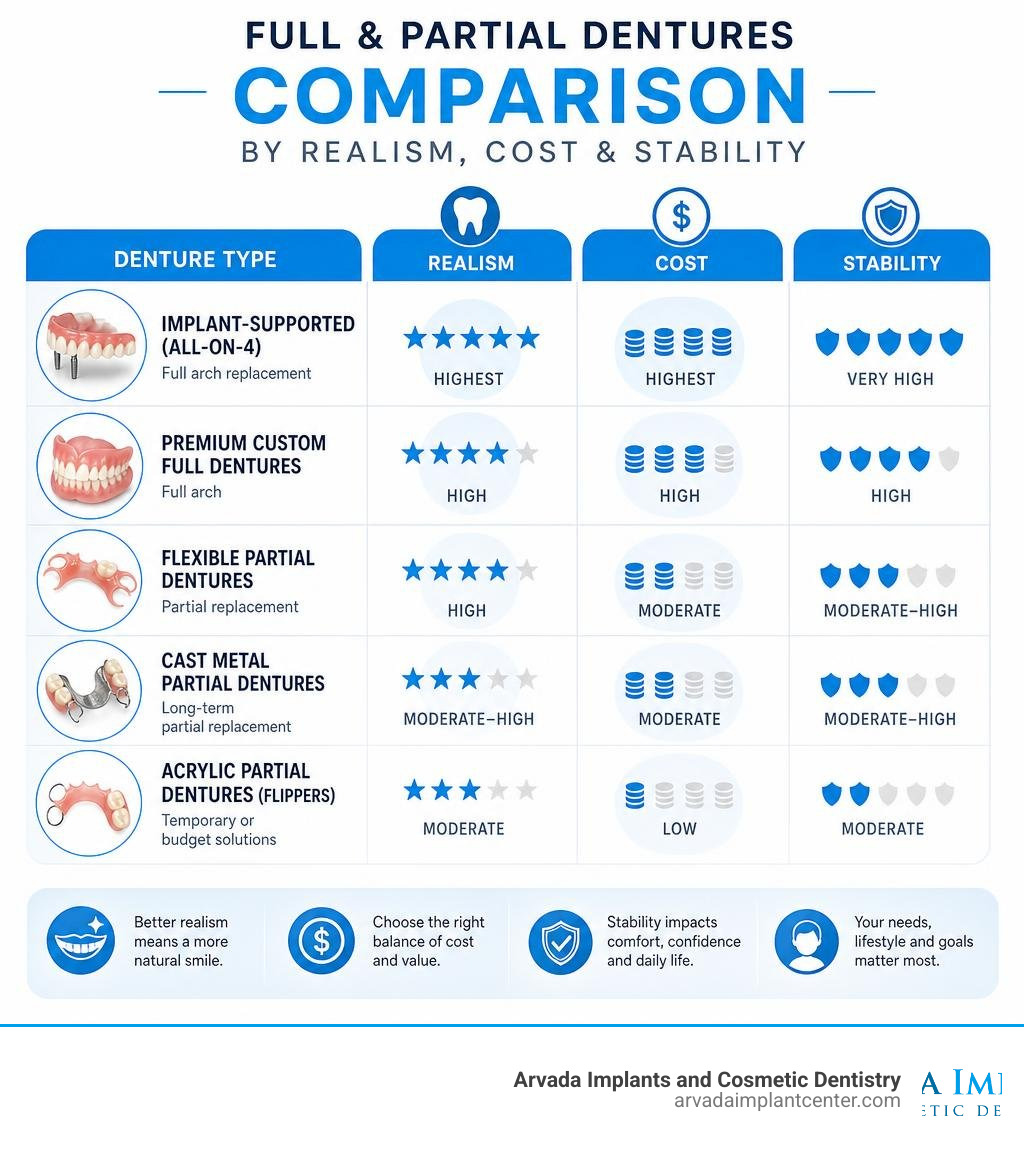
When it comes to most realistic full and partial dentures, these options consistently deliver the most natural appearance:
Denture Type Realism Level Best For Implant-supported (All-on-4) Highest Full arch replacement, bone preservation Premium custom full dentures High Full arch, budget-conscious patients Flexible partial dentures High Partial replacement, metal-free comfort Cast metal partial dentures Moderate-High Long-term partial replacement Acrylic partial dentures (flippers) Moderate Temporary or budget solutions
The closer a denture matches your natural gum color, tooth translucency, and facial structure, the less anyone will notice it's there.
Most people searching for realistic dentures share the same fear: will people be able to tell?
That worry is completely valid. Older dentures — and even some budget options available today — can look obviously artificial. The teeth appear too uniform. The gum base is the wrong shade. The overall effect makes you look different rather than better.
But modern dentures have changed dramatically. Today, materials like layered acrylic, porcelain, and flexible thermoplastic bases, combined with digital fabrication tools, can produce results that are genuinely hard to distinguish from natural teeth. The gap between "looks fake" and "looks real" comes down to materials, customization, and the skill of your dental team.
This guide walks you through every option — from affordable partials to premium implant-supported solutions — so you can choose what actually fits your needs, budget, and lifestyle.
I'm Dr. Tariq Sawaqed, cosmetic and implant dentist with over 20 years of experience helping patients in Colorado restore natural-looking smiles using the most realistic full and partial dentures available today. As the founder of Arvada Implants & Cosmetic Dentistry, I've seen how the right denture — properly fitted and customized — can completely change how a person feels about their smile.
What Makes Dentures Look Natural?
Achieving a natural-looking smile isn’t just about choosing the whitest teeth in the catalog. In fact, selecting ultra-bright, perfectly uniform teeth is the fastest way to make your dental work look artificial. Real teeth aren't perfect, and they certainly aren't opaque white.
To create truly natural looking dentures, several subtle, artistic details must come together:
Light Transmission and Enamel Translucency: Natural tooth enamel is semi-translucent, meaning light passes through the outer edges and reflects off the deeper, opaque dentin layer. Premium denture teeth mimic this property by using layered acrylic or high-quality porcelain, giving them depth instead of a flat, plastic look.
The Gum-Line Transition Zone: This is where many poorly made dentures fail. In a realistic denture, the acrylic base must mimic natural gum tissue, including the tiny blood vessels (veining), varying shades of pink, and the natural "stippling" (texture) of healthy gums.
Asymmetry and Characterization: Perfectly straight, identical teeth look like a picket fence. Real smiles have slight imperfections—a minor rotation here, a slightly shorter lateral incisor there. High-end custom dentures are handcrafted with these tiny variations to fit your age and unique facial character.
Facial Symmetry and Lip Support: Missing teeth cause the muscles in your cheeks and lips to sag inward, which leads to a prematurely aged, sunken appearance. A properly designed denture provides the exact amount of support needed to restore your natural facial contours without looking "stretched" or overly stuffed.

The Most Realistic Full and Partial Dentures: Material & Type Comparison
To find the right fit for your mouth, it helps to understand the different types of dentures and how their materials impact both their look and daily function.
Cast Metal Partial Dentures
Considered the "gold standard" for long-term structural integrity, these partials feature a thin, strong medical-grade metal framework (often cobalt-chromium) covered by pink acrylic and custom denture teeth. They are highly stable and transfer chewing forces beautifully. However, they rely on small metal clasps that attach to your remaining teeth, which can sometimes be visible when you laugh or speak.
Acrylic Partial Dentures (Resin/Flippers)
These are made of a rigid pink acrylic base. While they are lightweight and highly affordable, they are thicker and bulkier than metal-based options. Because they are more prone to breaking, they are typically used as temporary solutions (often called "flippers") while a patient heals from extractions.
Flexible Thermoplastic Partials
Made from a thin, biocompatible nylon material, flexible partials are incredibly popular for those prioritizing aesthetics. They contain no metal clasps. Instead, the clear or pink material contours directly to your natural gum line, blending in seamlessly. They are highly comfortable and move naturally with your mouth, though they can be slightly more difficult to adjust or reline later.
Here is a direct breakdown of how these three primary partial options compare:
Feature Cast Metal Partials Acrylic Partials (Resin) Flexible Partials Aesthetic Realism Moderate to High (clasps may show) Moderate (bulkier base) High (blends with natural gums) Material Strength Extremely High Moderate (prone to cracking) High (virtually shatterproof) Average Cost $2,229 (Range: $1,728 - $4,203) $1,738 (Range: $1,333 - $3,283) $1,761 (Range: $1,360 - $3,451) Comfort Level High (very stable, thin) Low to Moderate (bulky) High (lightweight, adapts to mouth) Lifespan 5 to 10+ years 1 to 3 years (temporary) 3 to 7 years
Choosing the Most Realistic Full and Partial Dentures for Your Lifestyle
When selecting a prosthetic, you must weigh your aesthetic goals against your daily comfort, budget, and physical needs. For example, if you still have healthy natural teeth remaining, your priority should be protecting them.
According to our ultimate partial dentures guide, a high-quality partial denture does more than fill gaps—it actively prevents your remaining teeth from shifting out of alignment. Working with an experienced local dental team can help you navigate these choices and find the perfect solution for your unique smile.
Flexible vs. Acrylic Bases for Partial Restorations
If you are choosing between a flexible base and a traditional acrylic base, the decision often comes down to how long you plan to wear the prosthetic.
Our ultimate flexible partial dentures guide highlights that biocompatible nylon bases are excellent for patients with sensitive gums or metal allergies. Because they don't require metal clasps, they offer superior tissue blending. However, if you are looking for a highly budget-friendly, temporary option while waiting for an implant to heal, a standard acrylic flipper (averaging around $605) is usually the most practical route.
Implant-Supported vs. Traditional Removable Dentures
If you are facing complete tooth loss on an upper or lower arch, traditional removable dentures are no longer your only option. Today, we can combine the aesthetics of premium dentures with the life-changing stability of dental implants.
Traditional removable dentures rest directly on top of your gum tissue. While they can look incredibly realistic when crafted by a skilled lab, they do nothing to prevent a biological process called bone resorption. For general patient education on how dentures work and why proper fit matters, the American Dental Association offers an overview of dentures.
When you lose your teeth, your jawbone no longer receives stimulation from chewing forces. Over time, the bone naturally begins to shrink and melt away. This leads to "facial collapse," causing the mouth to look sunken and the chin to move closer to the nose. As the bone shrinks, your dentures lose their grip, leading to slipping, clicking, and the need for messy adhesives.
Implant-supported options change the game entirely. By placing titanium posts directly into the jawbone, we mimic the roots of your natural teeth. This preserves your bone structure, locks your teeth firmly in place, and eliminates the bulkiness of a traditional denture.
Let's look at how these options compare:
Traditional Removable Dentures: Cost-effective (averaging $1,968) and non-invasive, but they require regular relines as your jawbone changes shape over time.
Overdentures / Snap-On Dentures: These cost an average of $3,136 (snap-on options average $2,480). They utilize 2 to 4 implants. You still remove them at night to clean them, but they "snap" securely onto the implants, eliminating slippage.
Fixed Hybrid Dentures (All-on-4): These are permanently secured to 4 or more implants. They do not cover the roof of your mouth, they feel exactly like natural teeth, and you brush them just like your original smile. They offer the ultimate level of realism and stability.
To explore which path is right for your anatomy, check out our detailed comparison of dentures vs implants.
The Customization Process: Achieving a Seamless Fit
Creating the most realistic full and partial dentures is a highly personalized process that blends advanced dental science with artistic design. It is not a one-size-fits-all procedure.
According to our complete guide to full and partial dentures in 2026, your journey to a natural smile involves several key milestones:
Initial Consultation & Diagnostics: We evaluate your oral health, jawbone density, and facial aesthetics.
Digital or Physical Impressions: We capture the exact contours of your gums and remaining teeth.
The Wax Try-In: This is the most critical step for realism. Before the final denture is cast, we create a temporary wax version. You get to wear this try-in to evaluate the tooth shape, shade, and overall fit in the mirror. We can make adjustments right then and there.
Final Processing & Delivery: The lab fabricates your custom denture using high-impact polymers or porcelain.
Post-Delivery Adjustments: Your mouth will need a few weeks to adapt, and we will schedule follow-up appointments to buff away any minor sore spots.
How Digital Technology Delivers the Most Realistic Full and Partial Dentures
The dental industry has been completely revolutionized by digital workflows. At our Arvada practice, we utilize state-of-the-art CAD/CAM (Computer-Aided Design and Computer-Aided Manufacturing) and 3D printing to elevate patient care.
As detailed in our guide on the best dentures for precise fit and natural look, digital dentures are milled from a single, pre-shrunk, high-density acrylic puck. This monolithic milling process means the denture base is incredibly strong, perfectly stable, and matches the digital scan of your mouth with sub-millimeter accuracy. This results in a tighter suction fit, fewer sore spots, and a significantly faster turnaround time.
Selecting the Perfect Shade and Shape for Your Face
Choosing a tooth shade is a delicate science. If you choose a shade that is too bright, it will look artificial. If you choose one that is too dark, it won't give you the youthful rejuvenation you desire.
When designing your smile, we analyze:
Your Skin Tone & Complexion: Warmer skin tones pair beautifully with soft, natural ivory shades, while cooler skin tones can handle brighter whites without looking washed out.
The Sclera (Whites of Your Eyes): As a general rule of thumb, your denture teeth should not be brighter than the whites of your eyes.
Your Age: Natural teeth naturally darken and show minor wear over time. To ensure your smile looks age-appropriate and authentic, we select teeth with subtle gradient shading and natural translucency.
Gingival Shading: We offer a range of gum shades to ensure the pink base of your denture perfectly matches your natural gum tissue.
For more on how we customize these details, read our guide on the best dentists for natural looking full dentures. No matter where you are located in Colorado, finding a skilled restorative dentist who prioritizes customization is the key to achieving a beautiful, lifelike result.
Frequently Asked Questions About Realistic Dentures
How long do the most realistic dentures typically last?
On average, high-quality traditional removable dentures last between 5 to 7 years, while premium custom options can last up to 10 years with exceptional care. Over time, your jawbone naturally changes shape, meaning your dentures will eventually need to be professionally relined or replaced to maintain their precise fit and natural appearance. Implant-supported dentures are highly durable, with the implant posts lasting a lifetime and the prosthetic teeth lasting 10 to 15+ years before needing wear-and-tear maintenance.
Do realistic dentures require special adhesives to stay in place?
No! A properly fitted, custom-designed denture should stay securely in place using only natural suction (for upper dentures) and the natural control of your cheek and tongue muscles (for lower dentures). While temporary adhesives can provide a boost of confidence during the initial learning curve, chronic dependency on adhesives is usually a sign that your denture fits poorly and needs to be adjusted or replaced. If you want absolute, slip-free security without any adhesives, implant-supported snap-on options are your best choice.
What factors influence the cost of premium custom dentures?
Several key elements determine the final cost of your smile transformation:
Material Quality: Premium porcelain teeth and high-impact, multi-layered acrylics cost more than standard, flat-looking plastic teeth.
Lab Fabrication: Hand-characterized, customized dentures require the artistry of master dental technicians, which carries a higher price point than mass-produced "economy" dentures (which average around $452).
Surgical Needs: If you require extractions, bone grafting, or dental implants, these preparatory procedures will impact your total investment.
For a comprehensive breakdown of these financial options, explore our guide on dentures vs implants cost.
Conclusion
Losing your teeth can feel like losing a piece of your identity, but you do not have to settle for a fake-looking smile. Modern dentistry allows us to craft beautiful, lifelike prosthetics that blend seamlessly with your natural features, giving you back the freedom to eat, speak, and laugh without a second thought.
At Arvada Implants & Cosmetic Dentistry, we specialize in creating custom, personalized smiles that reflect who you are. Whether you are interested in a lightweight flexible partial, a premium custom full denture, or the absolute stability of implant-supported teeth, we are here to guide you every step of the way.
Are you ready to discover how natural your smile can truly look? Contact us today to schedule your personalized consultation, or explore our full and partial dentures service page to take your first step toward a more confident tomorrow.