
No Waiting, No Worries: The Best Dental Insurance for Immediate Dentures
Why Finding Dental Insurance That Covers Dentures With No Waiting Period Is So Hard (And What Actually Works)
Dental insurance that covers dentures with no waiting period exists — and several plans offer it right now. Here are the top options to know:
Provider Plan Name Waiting Period for Dentures Coverage Rate Spirit Dental Full Coverage PPO None Starts day one UnitedHealthcare DV 2000 / DV 3000 (65+) None 50% UnitedHealthcare DVH 2000 / DVH 3000 (65+) None 50% UnitedHealthcare Premier Choice None (graduated) 10% year 1, 50% year 2+ Humana Complete Dental PPO 12 months (waivable) 50% after deductible DentalWise Max Plan 1000–3000 None (graduated) 15% year 1, 50% year 2+
Quick answer: If you need dentures now, your best bets are Spirit Dental's no-wait PPO plans or UnitedHealthcare's senior DV/DVH plans (for those 65+). Most other major insurers impose a standard 12-month wait for major restorative work like dentures — though that wait can sometimes be waived with proof of prior continuous coverage.
Most people don't realize this until after they've already signed up for a plan. You buy dental insurance expecting help with a new set of dentures, only to discover you have to wait a full year before the coverage kicks in for major services. That's a long time to wait when you're dealing with missing teeth, difficulty eating, or lost confidence in your smile.
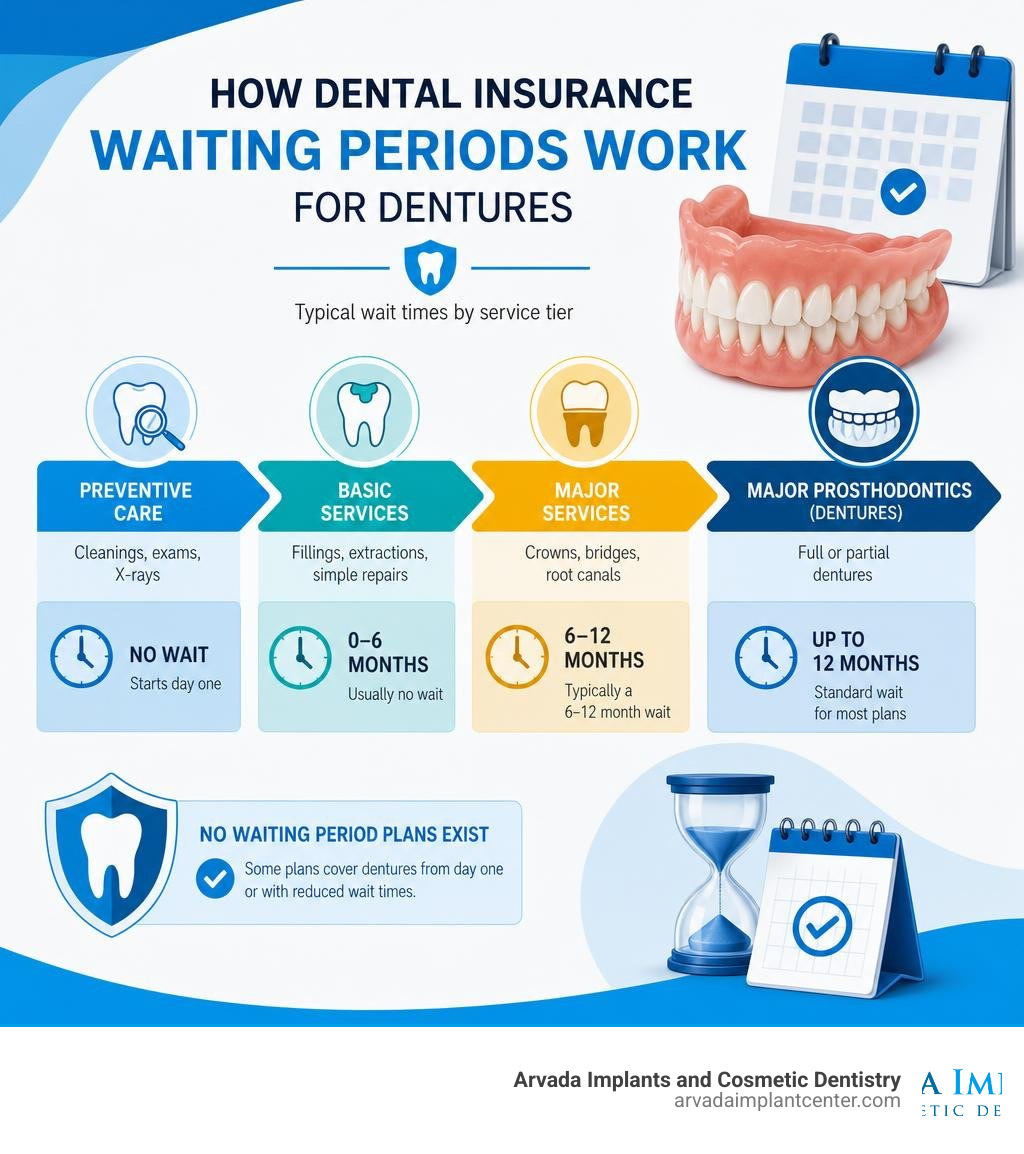
The reason insurers use waiting periods is simple: they're designed to prevent people from buying coverage only when they need an expensive procedure right away. As Delta Dental explains, a 12-month waiting period for major services like dentures is considered industry standard across most plans.
But standard doesn't mean universal. There are real plans — from real insurers — that cover dentures from day one or close to it. The catch is knowing exactly what to look for, because terms like "no waiting period" and "full coverage" can be misleading. A plan might skip the waiting period but only pay 10–15% of your denture costs in the first year. That's still better than nothing, but it's not the same as full immediate coverage.
This guide cuts through the confusion. We compare the top plans side by side, explain what "no waiting period" actually means in practice, and help you find the right fit for your situation and budget.
I'm Dr. Tariq Sawaqed, CEO of Arvada Implants and Cosmetic Dentistry and a DDS with over 15 years of clinical experience helping patients restore their smiles with dentures and implants. I've guided thousands of patients through the process of finding dental insurance that covers dentures with no waiting period, and I'll share exactly what works — and what to watch out for.
Understanding Full Coverage and Denture Benefits
When shopping for dental insurance, you will frequently see the term "full coverage." It is one of the most misunderstood phrases in the insurance world. To be perfectly clear: "full coverage" does not mean the insurance company pays 100% of your dental bills.
Instead, "full coverage" refers to the breadth of services the plan covers. A comprehensive plan typically splits dental care into three distinct tiers:
Preventive Care (Class I): Cleanings, exams, and routine X-rays. These are usually covered at 100%.
Basic Restorative Care (Class II): Fillings, simple extractions, and deep cleanings. These are typically covered at 70% to 80%.
Major Restorative Care (Class III): Deep treatments like crowns, bridges, and full or partial dentures. These are usually covered at 50% coinsurance.
Because dentures fall under Class III major restorative care, you will almost always be responsible for a coinsurance payment (usually 50% of the negotiated network rate) after you meet your annual deductible.
Additionally, every plan has an annual maximum benefit. This is the absolute limit on what the insurance company will pay for your dental care in a single calendar year. Typical annual maximums range from $1,000 to $3,000. If your new dentures cost $2,500 and your plan has a 50% coinsurance rate with a $1,000 annual maximum, the insurance will cover $1,000 (reaching your maximum), and you will pay the remaining $1,500 out of pocket.
Understanding how these tiers, coinsurance rates, and maximum limits interact is essential when calculating your true costs. For a deeper dive into how different plans structure these benefits, you can read our detailed guide on Dental Insurance for Dentures. If you are still deciding between standard dentures or permanent implant-supported options, we also break down the financial differences in our guide on Dentures vs Implants Cost.
Finding Dental Insurance That Covers Dentures with No Waiting Period
If you need a new smile today, waiting 12 months is simply not an option. Fortunately, you can find dental insurance that covers dentures with no waiting period if you look for specific plan structures.

When searching for immediate coverage, you will generally choose between two primary types of insurance plans:
Dental Preferred Provider Organizations (DPPOs): PPO plans offer the greatest flexibility. You can visit any dentist you like, though you will save the most money by staying within the insurer's network of preferred providers. Many DPPOs have standard waiting periods, but specialized "no-wait" PPOs bypass this restriction by using graduated benefits instead.
Dental Health Maintenance Organizations (DHMOs): DHMO plans typically feature lower premiums and zero waiting periods for all services, including major care. However, they require you to choose a single primary care dentist and restrict you entirely to their network. If you need specialized prosthodontic care, getting a referral can sometimes be a slow and frustrating process.
To understand how these options compare, you can read more about Dental Insurance with No Waiting Period options.
For most patients, a PPO plan with graduated benefits or a senior-specific specialty plan provides the best balance of immediate access and freedom of choice.
How to Choose Dental Insurance That Covers Dentures with No Waiting Period
Not all "no-waiting-period" plans are created equal. When evaluating your options in Colorado, pay close attention to the following details:
Deductibles: Most plans require you to pay a small deductible (usually $50 to $100) before coverage begins. However, some companies offer a "lifetime deductible." With a lifetime deductible, you only pay the fee once for as long as you remain on the plan, rather than watching it reset every January.
Network Restrictions: Always verify that your chosen dentist is in-network. If you visit an out-of-network provider on a PPO plan, the insurance company may only pay a percentage of the "Usual, Customary, and Reasonable" (UCR) fee, leaving you responsible for the rest of the bill (a practice known as balance billing).
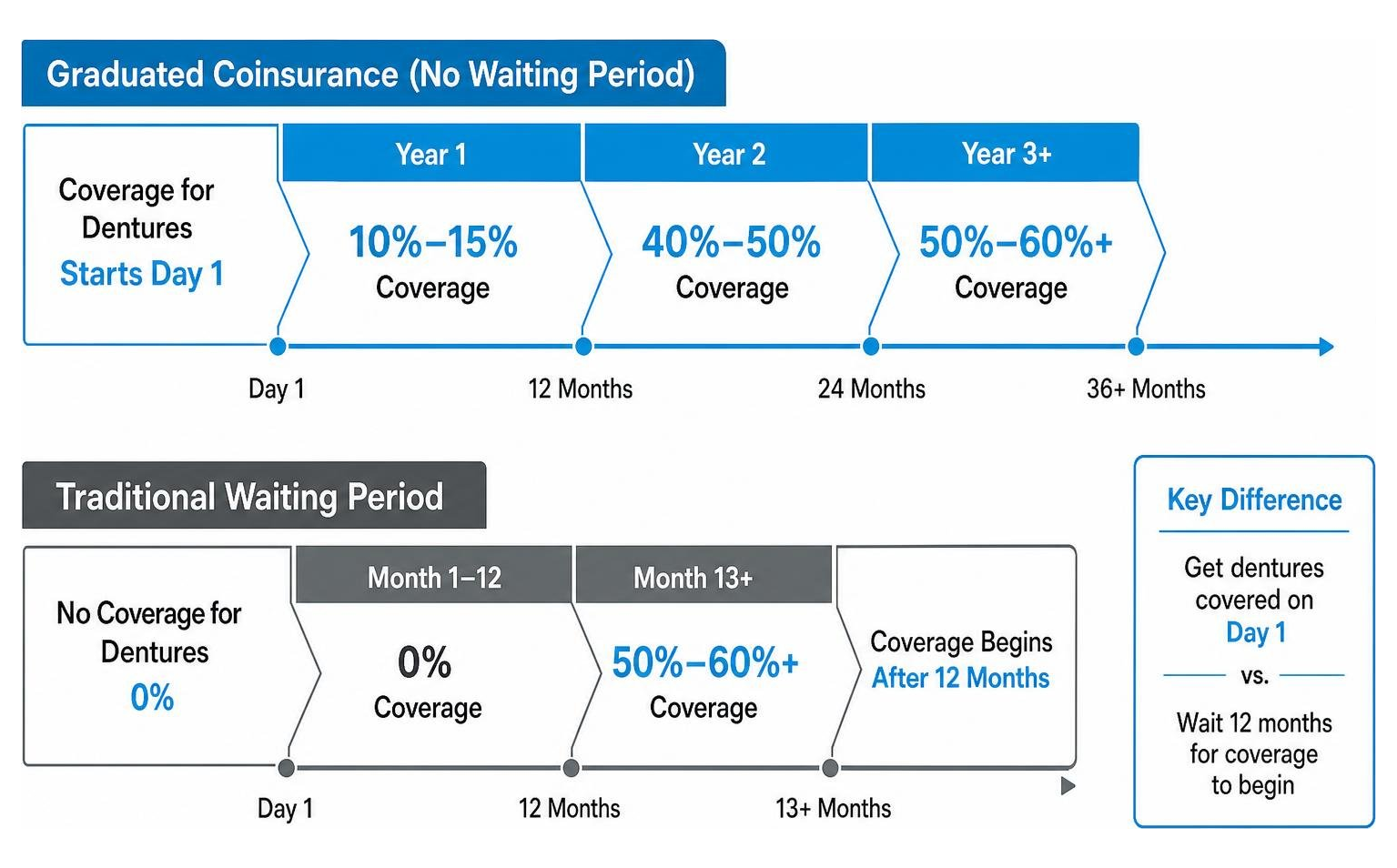
Graduated Coinsurance: Many plans that boast "no waiting period" for major services use a graduated payout scale. This means they will let you get dentures on day one, but they may only cover 10% to 15% of the cost in your first year. In the second year, coverage typically jumps to 40% or 50%.
For a comprehensive look at how we process insurance and help you maximize your benefits, visit our Insurance and Finance page.
To visualize how these different plan structures affect your timeline and out-of-pocket costs, review the comparison diagram below:
Top Providers of Dental Insurance That Covers Dentures with No Waiting Period
Several national insurance providers offer plans designed to help you bypass the standard 12-month delay. Here are the top programs available for Colorado residents in July 2026:
1. Spirit Dental (Full Coverage PPO)
Spirit Dental is famous for offering comprehensive PPO plans with absolutely no waiting periods for preventive, basic, or major care.
How it works: Your coverage for dentures begins the very same day your plan starts.
The Details: Instead of a waiting period, Spirit uses a graduated coinsurance model. They also offer a one-time lifetime deductible rather than an annual resetting deductible.
Learn more directly from Dental Insurance With No Waiting Periods | Spirit Dental & Vision.
2. UnitedHealthcare (DV / DVH Senior Plans)
For adults age 65 and older, UnitedHealthcare offers specialized Dental & Vision (DV) and Dental, Vision, & Hearing (DVH) plans.
How it works: Under the DV 2000/3000 and DVH 2000/3000 plans, major services like full and partial dentures are covered at 50% starting on day one.
The Details: There is zero waiting period for dentures, though dental implants under the same plans still carry a strict 12-month wait.
3. UnitedHealthcare Premier Choice
If you are under 65, UnitedHealthcare’s Premier Choice plan offers an alternative path to immediate care.
How it works: This PPO plan covers major services with no waiting period, but it uses a steep graduated coinsurance scale.
The Details: The plan pays 10% for dentures in Year 1, 40% in Year 2, and 50% in Year 3.
4. Humana (Complete Dental PPO)
Humana’s Complete Dental plan is an excellent option if you are transitioning from another plan.
How it works: The plan has a standard 12-month wait for major restorative work, but this wait can be completely waived if you show proof of 12 months of continuous prior dental coverage.
The Details: Once active or waived, the plan covers dentures at 50% after your deductible is met.
Explore plan specifics at Complete PPO Dental Insurance Plans | No Waiting Period.
Key Limitations: Exclusions, Missing Tooth Clauses, and Replacement Rules
Before you sign up for any policy, it is vital to read the fine print. Insurance companies protect their profit margins by writing specific exclusions into their contracts. If you aren't careful, you could buy a plan only to find your specific denture procedure is completely excluded.

The three most common traps to watch out for include:
The Missing Tooth Clause: This is the most common reason denture coverage is denied. If a tooth was lost or extracted before your insurance policy's effective date, the plan will not pay to replace it. This means if you have been missing teeth for years and buy a new policy to finally get a partial denture, the insurer may refuse to cover the appliance.
Replacement Frequency Limits (The 60-Month Rule): Almost all dental insurance policies restrict how often they will pay to replace a set of dentures. The industry standard is once every 5 years (60 consecutive months). If your current dentures break, get lost, or no longer fit after 3 years, your insurance will not pay for a replacement.
Cosmetic Exclusions: If you are getting dentures solely for aesthetic improvements rather than functional restoration, the insurance provider can label the treatment "cosmetic" and deny the claim entirely.
To see how these rules are applied in senior-focused plans, you can read about the specific terms in the Cigna Dental Plans for Seniors — Real Costs, What's Covered, the Waiting Period Fine Print - Budget Seniors analysis.
Bypassing Waiting Periods with Prior Coverage Waivers
If you already have dental insurance but are planning to switch to a new provider, you do not necessarily have to choose a low-paying graduated plan to avoid a waiting period. You can often secure a waiting period waiver.
Most major insurers (including Humana, Cigna, and Guardian) will completely waive their standard 6- to 12-month waiting periods for major restorative care if you meet the following criteria:
Continuous Coverage: You must prove you had comparable, continuous dental coverage for the past 12 consecutive months.
No Gaps: The gap between your old policy ending and your new policy starting must not exceed 63 days (some insurers limit this gap to 30 days).
Proof of Prior Insurance: You must submit a letter of prior coverage and a complete summary of benefits from your previous insurance carrier when you apply for your new plan.
By planning your transition carefully, you can swap insurance providers without losing your ability to get immediate, high-level coverage for your new dentures.
Frequently Asked Questions About Denture Insurance
Navigating dental insurance can feel like learning a second language. Here are clear answers to the questions we hear most often from our patients in Arvada, CO.
Does Medicare cover dentures for seniors?
Original Medicare (Parts A and B) does not cover routine dental exams, cleanings, or major restorative treatments like dentures. It only covers dental care if it is deemed medically necessary during an emergency hospital stay.
To get denture coverage as a senior, you must either purchase a standalone individual dental policy (like the UnitedHealthcare senior plans discussed above) or enroll in a Medicare Advantage plan (Part C) that specifically includes comprehensive dental benefits. For a detailed breakdown of how to navigate these options, see our guide on Dentures for Seniors on Medicare.
Can I get dental implants covered with no waiting period?
It is highly unlikely. While you can find plans that cover traditional dentures on day one, dental implants are treated with much stricter guidelines.
Most insurance companies classify implants as an elective or premium service. Even "no-waiting-period" plans like UnitedHealthcare's senior DVH 3000 plan impose a strict 12-month waiting period specifically for implants. If you are trying to decide which restorative option fits your budget and timeline, explore our resource on Affordable Dentures Dental Implants to compare your choices.
What are the out-of-pocket costs under a no-wait plan?
Your out-of-pocket costs will depend entirely on how your "no-wait" plan is structured.
If you use a graduated plan (like UnitedHealthcare Premier Choice), the plan may only cover 10% of the cost in your first year. If a set of dentures costs $2,000, the insurance pays $200, and you pay $1,800.
If you use a senior specialty plan with a 50% coinsurance rate and no wait, the insurance pays $1,000, and you pay $1,000 (assuming you have met your deductible and have not exceeded your annual maximum).
If you visit an out-of-network dentist, you may also be billed for the difference between the dentist's retail rate and the insurance company's maximum allowed charge. Always stay in-network to keep your out-of-pocket costs predictable.
Conclusion
Finding dental insurance that covers dentures with no waiting period requires a careful look at the fine print. Whether you choose a graduated-benefit PPO, a senior-specific specialty plan, or utilize a prior coverage waiver to skip the wait entirely, taking action today prevents minor dental issues from turning into expensive emergencies.
At Arvada Implants and Cosmetic Dentistry, we believe high-quality dental care should be accessible to everyone. We specialize in providing custom, personalized denture treatments designed to fit your unique facial structure and smile. Because we create our custom prosthetics in a specialized lab, we can deliver beautiful, comfortable, and highly durable results.
We understand that navigating insurance can be overwhelming. Our experienced office team is always here to help you maximize your benefits, file your claims, and find a solution that fits your budget. If your insurance doesn't cover the full cost of your treatment, we also offer flexible financing options. You can explore our Payment Plans to find a monthly payment that works for you.
Ready to restore your smile and reclaim your confidence? Contact us today to schedule your personalized consultation, or explore our comprehensive options for Full Partial Dentures to take the first step toward your new smile.