
How to Get the Most from Your Dental Insurance for Dentures
What You Need to Know About Dental Insurance for Dentures
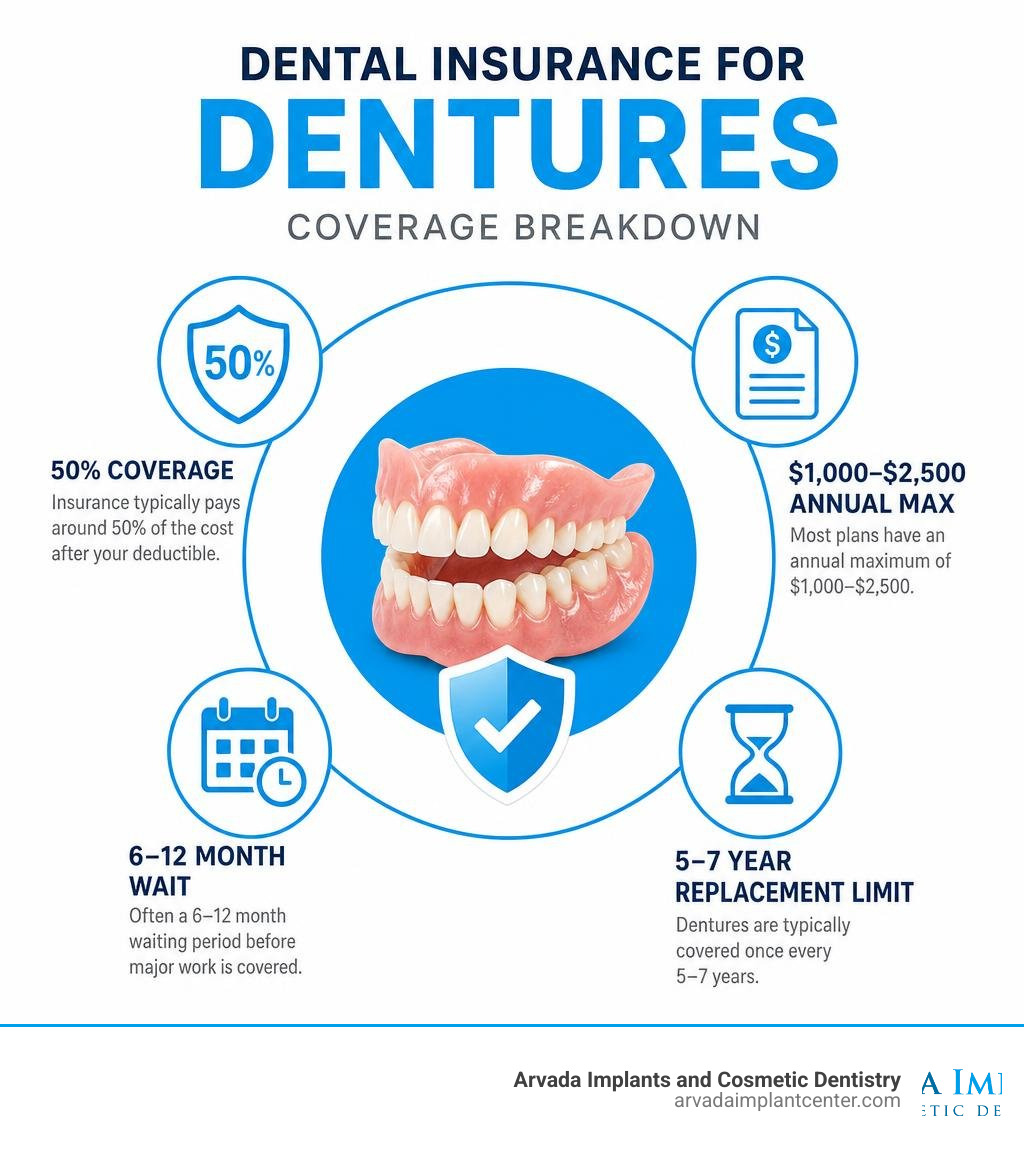
Dental insurance for dentures typically covers a significant portion of the cost — but rarely all of it. Here's a quick summary of how coverage usually works:
Coverage Type What to Expect Classification Dentures are classified as major restorative services Insurance pays Around 50% of the cost after your deductible Annual maximum Usually $1,000–$2,500 per year Waiting period Often 6–12 months before major work is covered Replacement limit Typically once every 5–7 years Missing tooth clause May deny coverage for teeth lost before your policy started Medicare Original Medicare does not cover dentures
Most people are surprised to learn that even with dental insurance, they can still face hundreds or thousands of dollars in out-of-pocket costs for dentures. A full set of conventional dentures can run anywhere from $1,500 to over $3,600, and insurance plans often cap their yearly payout well below that — meaning the math rarely works out the way patients hope.
The gap between what you expect your plan to cover and what it actually pays comes down to a handful of policy rules: annual maximums, waiting periods, and clauses buried in the fine print that many people never read until it's too late.
This guide walks you through exactly how dental insurance for dentures works, what the common pitfalls are, and how to get the most out of your benefits.
I'm Dr. Tariq Sawaqed, founder of Arvada Implants and Cosmetic Dentistry, and over my 20+ years of clinical experience I've helped thousands of patients navigate dental insurance for dentures to minimize out-of-pocket costs while restoring their smiles. I'll share what I've learned so you can go into this process informed and confident.
Understanding Dental Insurance for Dentures: Coverage and Classifications

When you start exploring how to pay for tooth replacement, the first thing to understand is how insurance companies categorize dental procedures. Most commercial insurance plans operate on what the industry calls a 100-80-50 coverage structure.
Under this standard model, dental procedures are grouped into three distinct tiers:
Preventive Services (100% covered): Routine cleanings, exams, and basic X-rays.
Basic Restorative Services (usually 80% covered): Simple fillings, non-surgical extractions, and emergency pain relief.
Major Restorative Services (usually 50% covered): Complex procedures like crowns, bridges, root canals, and dentures.
Because dentures replace multiple missing teeth and require custom dental lab fabrication, insurance companies almost universally classify them as major restorative services. This means that even if your plan is considered "full coverage," the insurance company will typically pay a maximum of 50% of the negotiated in-network rate. You will be responsible for the remaining 50% (your coinsurance), plus any applicable deductibles.
To understand how these costs compare to other tooth replacement options, it is highly beneficial to look at the long-term math. You can read more about this in our detailed breakdown of dentures vs implants cost. While dentures have a lower upfront cost, dental implants offer permanent structural benefits that can make them a more cost-effective investment over time.
How Dental Insurance for Dentures Classifies Different Types
Not all dentures are created equal, and your insurance plan may treat different styles of prosthetics differently.
Complete (Full) Dentures: These replace an entire arch of missing teeth (either upper, lower, or both). Insurance plans usually cover these at the standard 50% major restorative rate.
Partial Dentures: Designed for patients who still have some healthy natural teeth remaining, partials clip onto your existing teeth to fill the gaps. These are also classified as major restorative services.
Implant-Supported Dentures (Overdentures): These represent a hybrid approach. They look like traditional dentures but snap onto dental implants surgically embedded in your jawbone. This provides vastly superior stability, eliminates slipping, and preserves your jawbone health.
Because implant-supported dentures involve both a surgical component (the implants) and a prosthetic component (the denture itself), insurance coverage gets complicated. Many traditional plans classify dental implants as "cosmetic" or "not medically necessary," meaning they may cover 50% of the denture arch but 0% of the underlying implants.
However, coverage guidelines are evolving. For a look at how major carriers evaluate these procedures clinically, you can review the official Clinical guidelines on implant prostheses. To explore how we combine these technologies affordably in our practice, check out dentures with dental implants.
Out-of-Pocket Costs and Plan Types (PPO vs. DHMO)
The type of dental insurance plan you hold plays a massive role in your final out-of-pocket costs. The two most common structures are Dental Preferred Provider Organizations (PPOs) and Dental Health Maintenance Organizations (DHMOs).
Preferred Provider Organization (PPO): PPOs give you the freedom to see any licensed dentist, though you will save significantly by staying in-network. They use a co-insurance model (e.g., paying 50% for major services) but are capped by an annual maximum.
Dental Health Maintenance Organization (DHMO): DHMOs require you to see a designated primary care dentist within a strict network. Instead of percentages, they use a copay schedule (a fixed dollar amount for each procedure). While DHMOs typically do not have annual maximums or waiting periods, your choice of providers is highly restricted, and out-of-network care is generally not covered at all.
If you choose to go out-of-network with a PPO plan, you will likely face "balance billing." This happens because out-of-network dentists have not agreed to the insurance company's discounted fee schedule.
To help you visualize the average out-of-network costs across the United States, consider these typical price ranges:
Denture Type Average Out-of-Network Cost Range Full Lower Denture $1,115 – $2,425 Full Upper Denture $1,220 – $2,540 Partial Lower Denture $1,425 – $2,490 Partial Upper Denture $1,435 – $2,785
To understand how these plan structures directly impact your budget for implant-supported options, you can read our guide on clip in denture cost to see how dynamic pricing works in practice.
Key Policy Clauses and Exclusions That Affect Your Coverage

When shopping for dental insurance for dentures, the devil is entirely in the details. Insurance contracts are filled with specific clauses designed to limit the carrier's financial liability. Understanding these terms before you begin treatment is the difference between a smooth claim process and an unexpected multi-thousand-dollar bill.
Before committing to a specific treatment path, it is also wise to weigh all modern restorative options. For example, you can learn about the differences between permanent fixed options and removable options in our comprehensive comparison of hybrid dentures vs implants.
Navigating the Limitations of Dental Insurance for Dentures
There are three primary financial gates that control how much your insurance will pay for major dental work:
The Annual Maximum: This is the absolute limit on what your insurance company will pay for your dental care in a single benefit year (usually running from January to December).
About a third of commercial dental plans set their annual maximum between $1,000 and $1,500.
Nearly half of plans fall between $1,500 and $2,500.
Interestingly, only 3% to 5% of people with dental insurance actually hit their annual maximum in any given year. However, if you need dentures, you will almost certainly be in that small percentage. If a denture costs $3,000 and your plan covers 50%, you would expect the insurance to pay $1,500. But if your annual maximum is only $1,000, the insurance will stop paying at $1,000, leaving you to pay the remaining $2,000.
Deductibles: This is the flat fee you must pay out-of-pocket before your insurance benefits kick in. For individual dental plans, this is typically a modest $50 to $100, but it must be satisfied each benefit year.
Waiting Periods: To prevent people from buying insurance only when they need expensive work and canceling it immediately after, many policies enforce a waiting period. While preventive care is usually covered on day one, major restorative services like dentures often carry a 6 to 12-month waiting period. If you get dentures during this window, the insurer will deny the claim entirely.
For a deeper look into how these structural limits compare when choosing between traditional prosthetics and modern implant systems, read the Analysis of implants vs dentures coverage.
The Missing Tooth Clause and LEAT Rules
Two of the most frustrating clauses in dental insurance contracts are the Missing Tooth Clause and the LEAT (Least Expensive Alternative Treatment) Rule.
The Missing Tooth Clause: This clause states that if you lost a tooth before your current insurance policy's effective date, the plan will not pay for any prosthetic (such as a bridge, partial, or full denture) designed to replace that tooth. If you are missing multiple teeth and just one of them was lost prior to enrollment, the insurance company may use this clause to deny coverage for the entire partial denture.
The LEAT Rule (Least Expensive Alternative Treatment): If there are multiple clinically acceptable ways to treat your dental condition, the insurance company is only obligated to pay for the cheapest option. For example, if you are missing three teeth in a row, your dentist might recommend an implant-supported bridge for better health and stability. However, because a removable partial denture is cheaper and technically "clinically acceptable," the insurer will only pay the 50% share of what the partial denture would have cost, leaving you to cover the massive remaining balance.
Replacement Frequency Limits: Insurance companies will not pay for new dentures whenever yours get worn down or damaged. Most plans limit complete or partial denture replacement to once every 5 to 7 years. If your dentures break, warp, or no longer fit due to jawbone shrinkage before that limit is reached, you will have to pay for the replacement entirely out of pocket. (Note: Relines are typically covered once every 2 years to help maintain the fit of your existing denture).
To learn more about how to identify these traps in your specific policy, you can consult this practical Guide to denture insurance limits.
Government Programs: Medicare, Medicaid, and Denture Coverage
For seniors and low-income individuals in Colorado, navigating government-sponsored healthcare for dental needs requires understanding very specific rules.
Original Medicare (Parts A and B): By federal law, Original Medicare does not cover routine dental care, cleanings, extractions, or dentures. It only covers dental procedures that are an integral part of a covered surgical procedure (such as jaw reconstruction after an accident). This leaves a massive gap: an estimated 47% of Medicare beneficiaries had no dental coverage in 2019.
Medicare Advantage (Part C): These are private insurance plans approved by Medicare. Fortunately, coverage has expanded dramatically. In 2024, 98% of Medicare Advantage plans offered some dental benefits. However, you must read the specific plan's summary of benefits; some plans only cover basic preventive care, while others offer a dedicated allowance (often $1,000 to $2,000 annually) that can be applied toward major restorative services like dentures.
Medicaid (Health First Colorado): Medicaid is jointly funded by federal and state governments, meaning dental coverage varies wildly depending on where you live. Nationally, in 2021, only 31 states helped pay for dentures through their Medicaid programs.
Colorado Medicaid Rules: If you are a resident of Colorado enrolled in Health First Colorado (Colorado's Medicaid Program), you are in luck. Colorado provides an adult dental benefit that covers essential services, including partial and complete dentures, up to a specified annual cap. However, these services often require prior authorization from a Medicaid-enrolled dentist to prove medical necessity before treatment begins.
To understand the exact federal guidelines and exceptions regarding these programs, you can read the Medicare denture coverage details.
Smart Strategies to Maximize Your Benefits and Alternative Financing
If your dental insurance plan leaves you with a substantial balance for your dentures, don't panic. There are several highly effective strategies you can use to reduce your out-of-pocket costs and make treatment affordable.
Get a Pre-Treatment Estimate: Before we begin fabrication on your dentures, our administrative team can submit a "pre-treatment estimate" (also called a pre-determination) to your insurance carrier. This is a formal request where we outline the exact dental codes and costs. The insurance company reviews this and sends back a breakdown of exactly what they will pay and what you will owe. This completely eliminates surprise bills.
Phase Your Treatment (The "Year-Split" Strategy): If you need extractions, bone grafting, and dentures, doing everything in November or December can easily max out your annual limit. Instead, we can strategically phase your treatment. For example, we can perform necessary extractions and preparatory work in November of one year (using that year's annual maximum), and then fabricate and deliver your permanent dentures in January of the following year (utilizing a fresh annual maximum).
Utilize Tax-Advantaged Accounts (HSAs and FSAs): Both Health Savings Accounts (HSAs) and Flexible Spending Accounts (FSAs) allow you to set aside pre-tax dollars from your paycheck to pay for qualified medical and dental expenses. Because dentures are classified as a medical necessity, you can use these funds to cover 100% of your deductible, copays, and coinsurance.
Dental Discount Plans: If you do not have insurance, a dental savings or discount plan can be a fantastic alternative. For a small annual membership fee (usually under $150), you gain access to a network of dentists who have agreed to offer discounted rates (often 10% to 40% off) on major services like dentures, with no waiting periods or annual maximums.
If you are looking for flexible ways to break up your remaining balance into manageable monthly installments, we accept a wide variety of reputable third-party healthcare financing options:
CareCredit: Offers promotional interest-free periods (typically 6 to 24 months) for qualified patients.
Sunbit: Designed to be highly accessible, approving up to 90% of applicants with a soft credit check.
Proceed Finance: Specializes in larger loans (up to $60,000) with extended repayment terms for comprehensive implant-supported denture procedures.
LendingClub Patient Solutions: Offers flexible payment plans with low fixed rates.
PatientFi: Customizes payment plans based on your budget, focusing on friendly terms.
Cherry: Allows you to split treatment costs into smaller, bite-sized monthly payments.
To learn more about how we process claims and coordinate benefits, visit our dedicated page on insurance and finance, and check out our detailed guide on payment plans.
Frequently Asked Questions About Denture Insurance
Navigating insurance policies can feel like learning a completely different language. Here are clear answers to the most common questions we hear from patients in our Arvada office.
How long is the typical waiting period for dentures?
For major restorative services like dentures, the industry standard waiting period is 6 to 12 months from the date your policy becomes active. However, if you receive dental insurance through an employer-sponsored group plan, the waiting period is often waived entirely. Always check your specific plan details before scheduling your first extraction or impression appointment.
Will insurance cover replacement dentures if mine are damaged?
Generally, insurance will only pay for replacement dentures if your current set is at least 5 to 7 years old. If your dentures are damaged, lost, or no longer fit due to natural jawbone changes before this period is up, insurance will likely deny the replacement claim. However, minor repairs, professional cleanings, and relines (which adjust the plastic base to fit your changing gums) are usually covered once every 1 to 2 years under basic or major service benefits.
Can I use my HSA or FSA to pay for dentures?
Yes! Dentures, partials, and implant-supported prosthetics are fully recognized by the IRS as qualified medical expenses. You can use your HSA or FSA debit card to pay for any portion of your treatment that insurance does not cover, including your deductible and coinsurance. Using pre-tax dollars effectively saves you about 20% to 30% on your total out-of-pocket costs, depending on your tax bracket.
Conclusion
Getting dentures is a life-changing step that restores your ability to eat comfortably, speak clearly, and smile with absolute confidence. While navigating dental insurance for dentures can feel overwhelming, you do not have to do it alone.
At Arvada Implants and Cosmetic Dentistry, we specialize in providing affordable, highly personalized treatments with custom lab creations designed to fit your unique smile and facial structure. Our experienced administrative team will work directly with your insurance provider, submit all necessary pre-treatment estimates, and help you maximize every single dollar of your dental benefits.
If you are ready to explore your options for a healthier, more beautiful smile, Schedule a consultation for full or partial dentures with us today. We look forward to welcoming you to our Arvada practice!