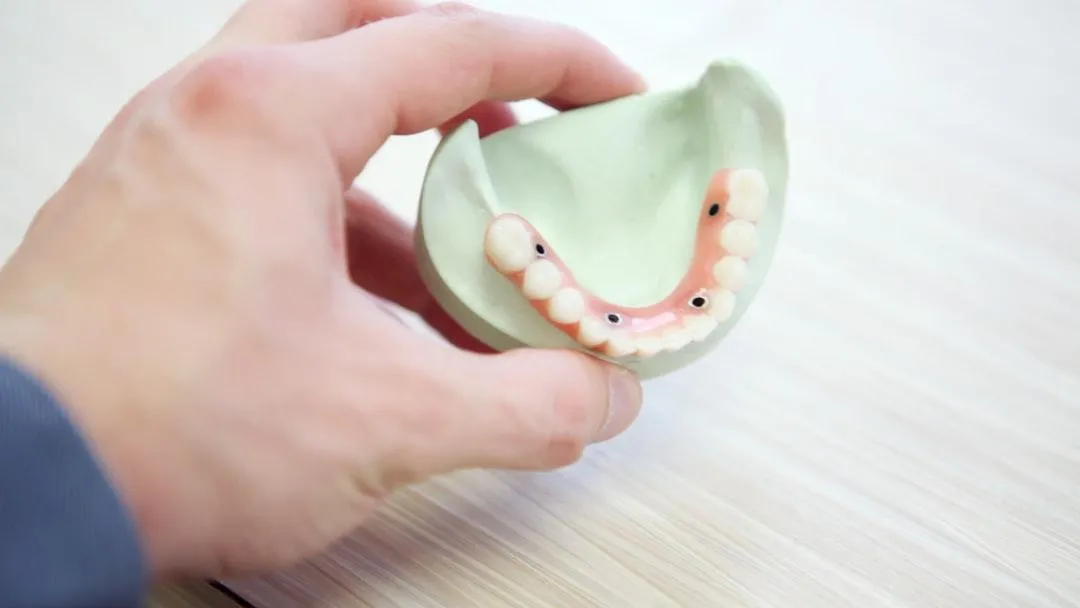
How Snap-In Dentures Work and Why They Click
How Snap-In Dentures Work — and Why So Many People Are Making the Switch
How does snap in dentures work is simpler than most people expect: small titanium implants are placed into your jawbone, and your denture physically clicks onto those implants using a built-in snap connector — giving you a secure, stable fit without messy adhesives.
Here's the quick version:
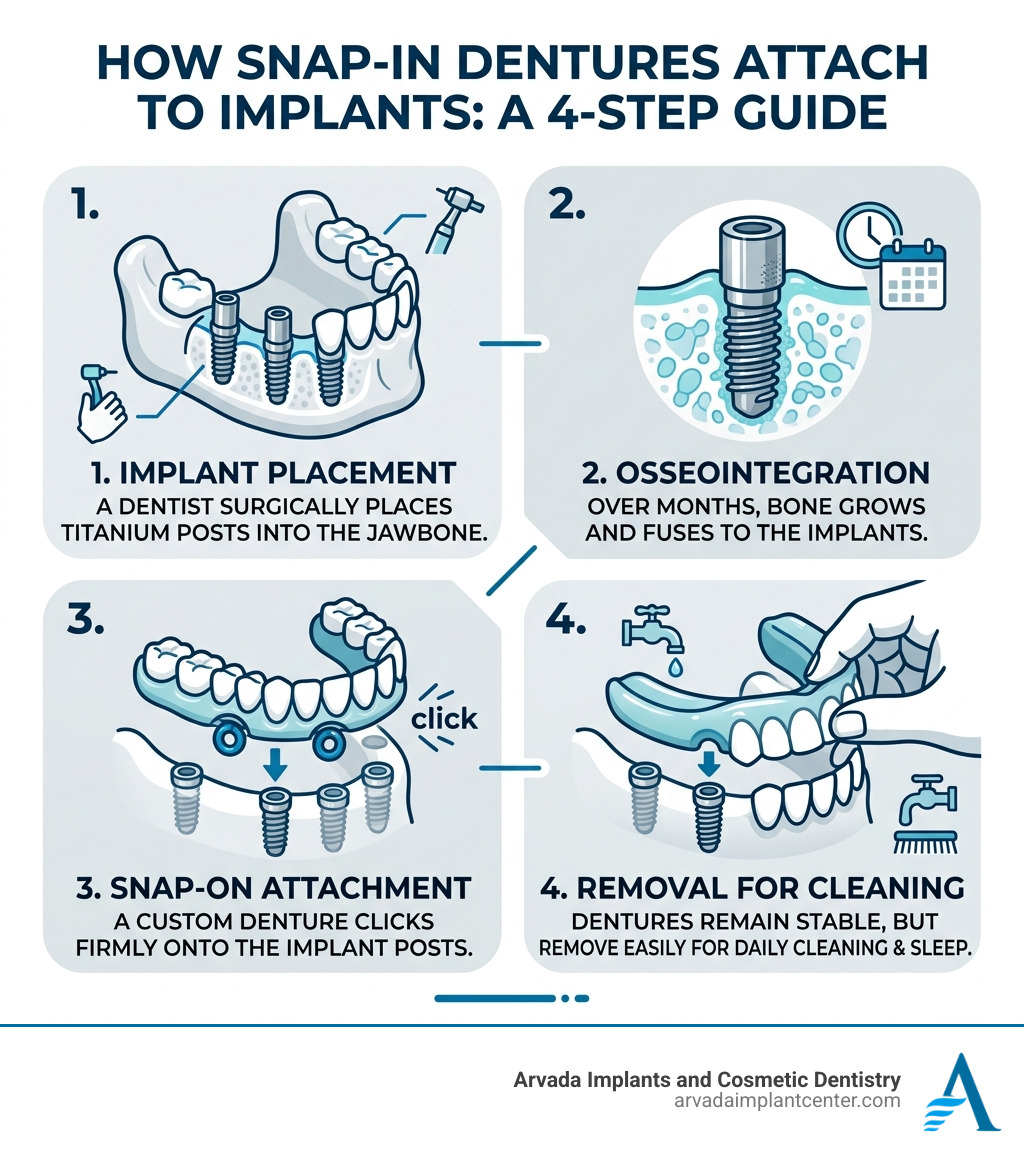
Implants placed — A dentist surgically places 2 to 4 titanium posts into your jawbone.
Bone fuses to implants — Over 3 to 4 months, your bone grows around the posts (called osseointegration).
Denture snaps on — A custom denture with built-in connectors clicks firmly onto the implants.
Remove at night — Unlike fixed implants, you take snap-in dentures out for cleaning and sleep.
The result? A denture that stays put while you eat, talk, and laugh — but still comes out easily when you need it to.
Around 36 million Americans have lost all of their teeth. Many of them are stuck with traditional dentures that shift, slip, and require sticky adhesives just to stay in place. It's frustrating, and it affects everything from what you can eat to how confident you feel in a conversation.
Snap-in dentures — also called implant-retained overdentures — were designed to solve exactly that problem. They sit at the practical midpoint between basic removable dentures and fully fixed implant bridges. You get dramatically more stability than traditional dentures, without the higher cost or complexity of a fully permanent solution.
This guide breaks down exactly how the mechanics work, what the process looks like, and whether snap-in dentures might be the right fit for you.
What Are Snap-In Dentures?
At its core, a snap-in denture is a custom-made prosthetic that replaces a full arch of teeth. While it looks very similar to a traditional denture on the outside, the "under the hood" technology is entirely different.
Traditional dentures rely on suction, the natural shape of your gums, and often a fair amount of messy adhesive to stay in place. Even with the best fit, they can shift when you bite into an apple or laugh suddenly. In contrast, snap-in dentures are implant-retained. This means they are anchored by titanium posts that act as artificial tooth roots.
These titanium posts serve two critical purposes:
Unmatched Stability: They provide a physical anchor so the denture cannot slide or "float" in the mouth.
Jawbone Preservation: One of the biggest downsides of missing teeth is that the jawbone begins to shrink because it no longer receives stimulation from tooth roots. Implants provide that stimulation, helping to keep your facial structure intact as you age.
Because they are still removable, they are often referred to as "overdentures." You get the best of both worlds: the security of implants and the hygiene convenience of a removable prosthetic. To learn more about how these compare to other tooth replacement options, check out our guide on full and partial dentures or explore the pros and cons of snap-in dentures.
How Does Snap-In Dentures Work Mechanically?
The magic of the "click" comes from a specialized mechanical attachment system. To understand how does snap in dentures work, you have to look at the three main components: the implant, the abutment, and the denture housing.
The Implant: This is a small titanium screw placed into the jawbone. Titanium is used because it is biocompatible, meaning the body doesn't reject it.
The Abutment (The Locator): Once the implant has healed, we attach a connector piece called an abutment. In snap-ins, the most common type is a "Locator" mount. This looks like a tiny metal button protruding slightly above the gumline.
The Housing: Inside the base of your custom denture, we install "male" attachment inserts (often made of high-strength nylon or O-rings). These inserts are designed to fit perfectly over the "female" locator mounts on your implants.
When you press the denture down, the nylon inserts stretch slightly and then "snap" over the metal locators. This provides a secure mechanical lock. Depending on your needs, we can even adjust the "retention" level—making the snap tighter or looser based on your hand strength and comfort. For a deeper dive into the science of these anchors, you can read this scientific overview of snap-in benefits or see our general page on dental implants.
How many implants are required for how does snap in dentures work?
A common question we hear at Arvada Implants and Cosmetic Dentistry is how many implants are actually needed to get that secure fit. While every mouth is different, the standard range is 2 to 6 implants per arch.
Lower Arch: Because the lower jawbone is denser, we can often achieve great stability with just 2 implants. This is a very popular, cost-effective way to stop a lower denture from "dancing" around while you talk.
Upper Arch: The bone in the upper jaw is typically softer, and the denture has to fight gravity. Therefore, we usually recommend a minimum of 4 implants for the upper arch to ensure it stays firmly in place.
Maximum Stability: For patients who want the absolute highest level of security, using 6 implants provides a foundation that feels almost indistinguishable from natural teeth.
The number of implants depends largely on your bone density and your lifestyle goals. If you have multiple missing teeth, we use 3D imaging to find the strongest points in your jaw to place these anchors.
The role of locators in how does snap in dentures work
The "Locator" system is the industry standard for snap-in technology. These male-female connectors are designed to be self-aligning. This means you don't have to be a surgeon to put your teeth in every morning; the denture almost "finds" the implants as you guide it into place.
The nylon housing units inside the denture act as shock absorbers. When you chew, these inserts allow for a tiny amount of vertical movement, which prevents the implants from taking too much direct stress. Over time (usually every 6–12 months), these nylon inserts may lose their "snap" as they wear down, but they are incredibly easy and inexpensive for us to replace during a routine office visit.
The Step-by-Step Process to Getting Your Smile Back

Getting snap-in dentures is a journey, but it is one that we have streamlined here in Arvada to be as comfortable as possible. As of May 2026, modern technology allows us to be more precise than ever.
1. The Consultation and 3D Imaging
Everything starts with a 3D Cone Beam CT scan. This allows us to see your jawbone in three dimensions. We check for bone density, nerve locations, and sinus cavities to plan the exact placement of your implants. We’ll discuss your goals and help you decide if snap-ins are the right choice for your lifestyle.
2. Surgical Placement
During a procedure that usually takes less than 90 minutes, we place the titanium implants into the jawbone. Most patients are pleasantly surprised that the recovery is much easier than a tooth extraction. We use local anesthesia or sedation to ensure you don't feel a thing.
3. The Osseointegration Phase (The Waiting Game)
This is the most important step. Over the next 3 to 4 months, your jawbone will actually grow into and fuse with the titanium implants. This process, called osseointegration, is what creates the "permanent" bond. During this time, you will wear a temporary denture so you are never without teeth.
4. Custom Fabrication and Fitting
Once the implants are solid, we take final impressions. Our custom lab creates a denture that is perfectly balanced to your bite and aesthetic preferences. We then install the locator abutments and "snap" your new smile into place. We’ll teach you how to click them in and out and ensure the fit is perfect. For more details on what to expect, check out this detailed process and recovery timeline or view our full list of dental services.
Comparing Snap-In Dentures vs. Fixed Implant Solutions
Many patients ask if they should get snap-in dentures or a fixed solution like "All-on-4." While both use implants, the experience is different.
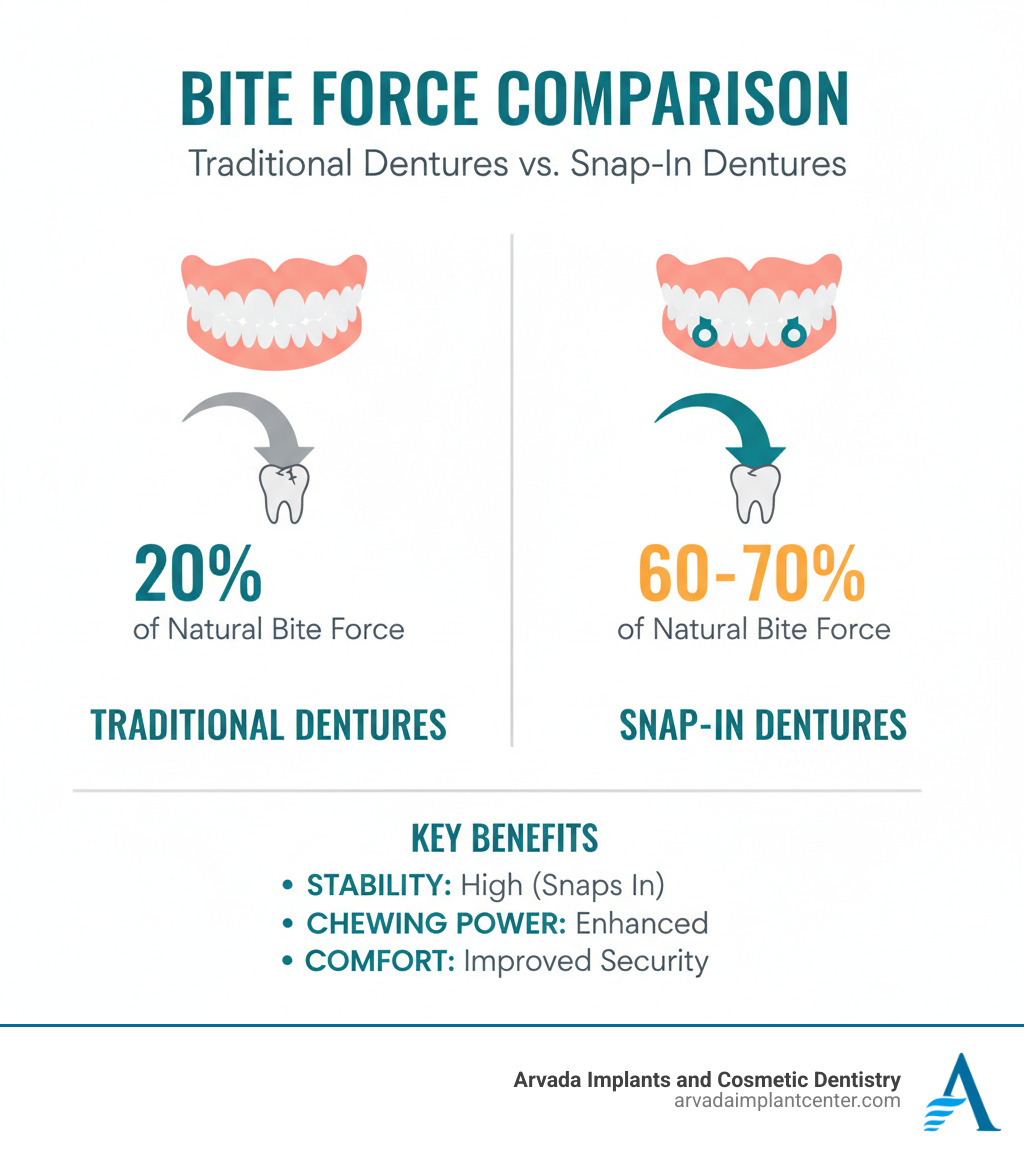
Feature Traditional Dentures Snap-In Dentures Fixed Implant (All-on-4) Stability Low (slips often) High (snaps in) Permanent (doesn't move) Bite Force ~20% of natural ~60-70% of natural ~90%+ of natural Palate Coverage Full (covers roof of mouth) Often Partial/Open None (Open palate) Removability Removable by patient Removable by patient Only by a dentist Maintenance High (adhesives) Low (daily cleaning) Low (brush like teeth) Cost Lowest Mid-Range Higher
The most significant jump is from traditional to snap-in. Research shows that people with snap-in dentures can bite with up to 300% more force than those with traditional dentures. This means steak, corn on the cob, and crunchy vegetables are back on the menu. For a deeper comparison, see our article on snap-in dentures vs. All-on-4 implants or learn about fixed implant dentures.
Cost, Longevity, and Candidacy in 2026
Investing in your smile is a big decision. As of May 2026, snap-in dentures remain one of the most cost-effective ways to get the benefits of implant dentistry.
Cost: At Arvada Implants and Cosmetic Dentistry, snap-in overdentures typically start around $5,995. This is significantly more affordable than fixed bridges, which can cost three to four times that amount.
Longevity: The titanium implants themselves are designed to last a lifetime. The denture prosthetic usually lasts 5 to 15 years before it needs to be replaced due to normal wear and tear on the acrylic teeth.
Survival Rate: Clinical studies show an incredible 92.5% survival rate for implants over a 20-year period.
Candidacy: Most people who are healthy enough for a routine dental extraction are candidates for implants. Even if you have been told you have bone loss, we can often use bone grafting or sinus lifts to create the necessary foundation. If you are only missing a few teeth, we also offer one missing tooth replacement options.
For a broader look at industry pricing, you can refer to the Healthline guide to costs and care.
Maintenance and Long-Term Care
One of the reasons people love snap-in dentures is how easy they are to maintain. However, because they are a mechanical system, they do require a little bit of "love" to keep them clicking perfectly.
Nightly Removal: Just like traditional dentures, you should take your snap-ins out at night. This gives your gum tissue a chance to breathe and prevents fungal infections.
Cleaning the Denture: Use a soft-bristled brush and a non-abrasive cleaner. Avoid standard toothpaste, as it can create microscopic scratches in the acrylic that harbor bacteria.
Cleaning the Implants: This is the most important part! You must brush the locator abutments (the little metal buttons) in your mouth with a soft toothbrush to keep them free of plaque and tartar.
The "Snap" Check: Every 6 to 12 months, the little nylon inserts inside your denture will wear down. You’ll notice the "click" feels a bit weaker. When that happens, just stop by our Arvada office, and we can swap them out for fresh ones in about 10 minutes.
For a full list of "do's and don'ts," refer to our denture home care instructions.
Frequently Asked Questions about Snap-In Dentures
Can you eat normally with snap-in dentures?
Yes! While no prosthetic is exactly like natural teeth, snap-ins bring you very close. You regain about 60-70% of your natural chewing ability. This is a massive upgrade from the 20% offered by traditional dentures. Most of our patients in Arvada report they can comfortably eat steak, apples, and even corn on the cob again. We just recommend taking it slow for the first few weeks as your muscles adjust to your new-found biting power.
How long is the recovery timeline after surgery?
The initial surgical recovery is quite fast. Most patients return to work within 2 to 3 days. You might experience some mild swelling or bruising, but it is easily managed with over-the-counter or mild prescribed pain medication. The "long-term" recovery is the 3 to 4 months it takes for the bone to fuse to the implants (osseointegration). During this period, you aren't in pain; you're just waiting for biology to do its work.
Can snap-in dentures be used with bone loss?
Absolutely. Many people believe that because they’ve worn dentures for years and have lost bone, they aren't candidates. In reality, we have several ways to help. We can perform bone grafts to add volume to the jaw or sinus lifts for the upper arch. Our advanced 3D imaging allows us to find "hidden" bone that traditional X-rays might miss. If you've been told "no" elsewhere, it’s worth a second look at our Arvada office.
Conclusion
At Arvada Implants and Cosmetic Dentistry, we believe that everyone deserves a smile that stays in place. Understanding how does snap in dentures work is the first step toward reclaiming your confidence, your diet, and your quality of life.
Whether you are tired of adhesives or are looking for a more affordable alternative to fixed bridges, snap-in dentures offer a life-changing solution that clicks. We take pride in our "all-under-one-roof" model, providing personalized treatment and custom lab creations right here in Arvada.
Ready to hear that satisfying "click" for yourself? Schedule a consultation for snap-in dentures with us today and let's get your smile back on track.