Hybrid Dentures vs. Implants: Navigating Modern Tooth Replacement
When Missing Teeth Force a Big Decision: Understanding Your Options
Choosing between hybrid dentures vs implants is one of the most important decisions you can make for your oral health, your confidence, and your daily quality of life. And with so many terms flying around — All-on-4, overdentures, fixed hybrids, individual implants — it's easy to feel lost before you even walk into a dental office.
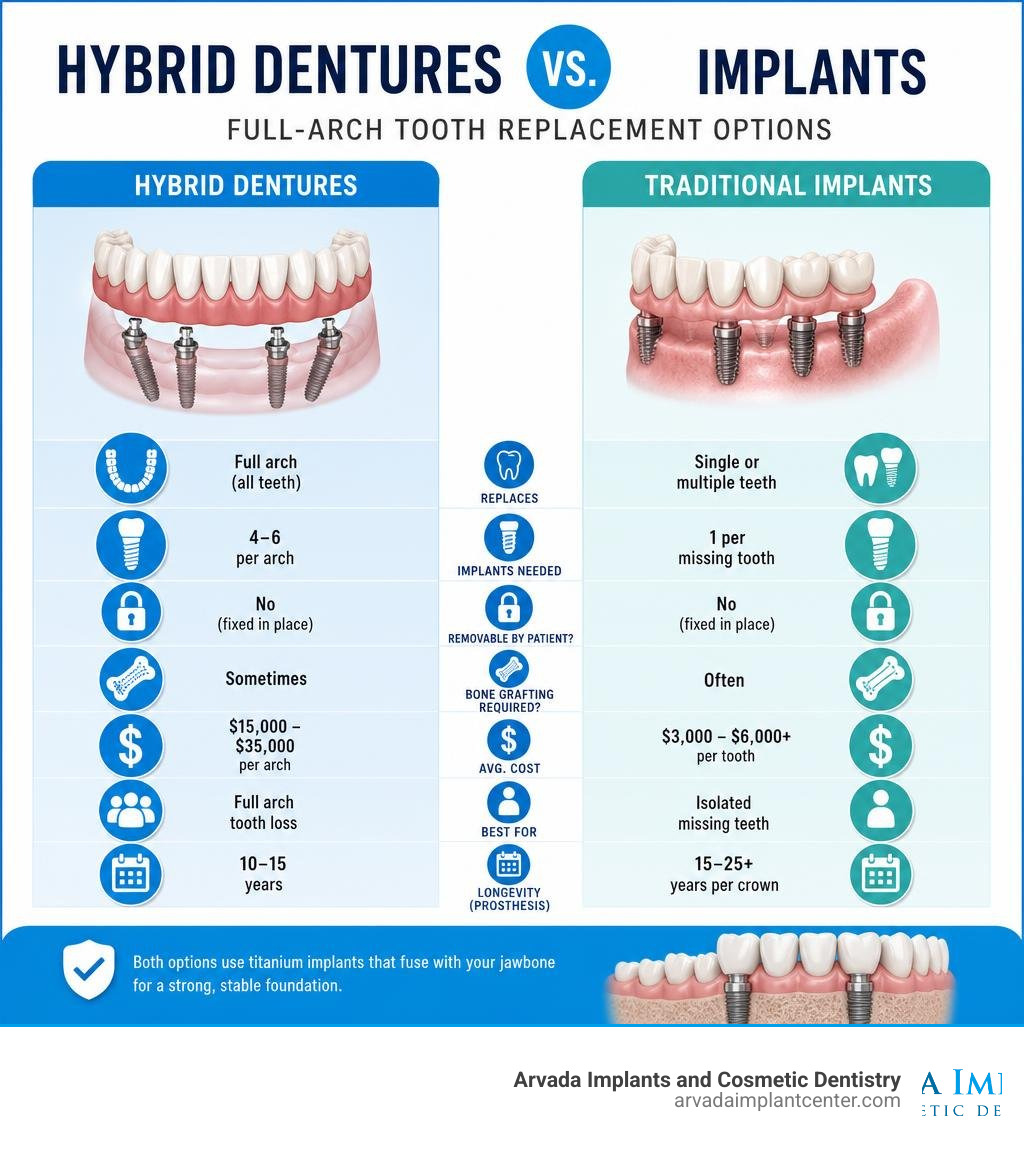
Here's a quick breakdown to answer your core question:
Feature Hybrid Dentures Traditional Implants Replaces Full arch (all teeth) Single or multiple teeth Implants needed 4-6 per arch 1 per missing tooth Removable by patient? No — fixed in place No — fixed in place Bone grafting required? Sometimes Often Avg. cost per arch $15,000 – $35,000 $3,000 – $6,000+ per tooth Best for Full arch tooth loss Isolated missing teeth Longevity (prosthesis) 10–15 years 15–25+ years per crown
The right choice depends on how many teeth you've lost, how much jawbone you have left, and what your budget looks like. Neither option is universally better — they solve different problems.
Losing most or all of your teeth changes how you eat, how you speak, and how you feel about yourself. Traditional dentures help, but they slip, they press on your gums, and they don't stop your jawbone from shrinking over time. That's why so many patients are now exploring implant-supported options — and getting confused by the terminology.
This guide cuts through the noise. You'll learn exactly what hybrid dentures and traditional implants are, how they compare on stability, cost, bone requirements, and daily maintenance — and which one might be the right fit for you.
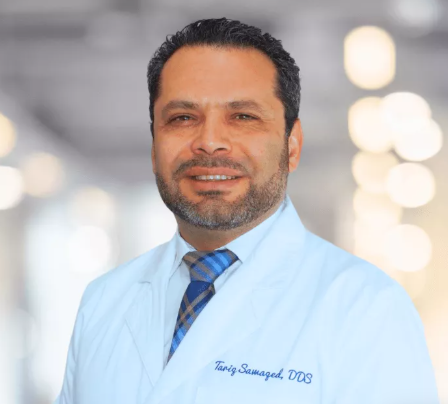
I'm Dr. Tariq Sawaqed, founder of Arvada Implants and Cosmetic Dentistry, and over more than two decades of clinical practice I've helped thousands of patients navigate the hybrid dentures vs implants decision using advanced 3D imaging, guided implant planning, and custom lab restorations. In the sections below, I'll walk you through everything you need to make a confident, informed choice.
Hybrid Dentures vs Implants: Key Differences
To truly understand how these systems compare, we have to look below the gumline. Both options rely on medical-grade titanium posts that are surgically placed into your jawbone. These posts act as artificial tooth roots, fusing with your natural bone through a process called osseointegration.
The primary difference lies in what sits on top of those implants. Traditional dental implants generally replace teeth on a one-to-one basis or support small bridges. A hybrid denture, however, is a single full-arch prosthesis designed to replace all the teeth on your upper or lower jaw using a strategic, minimal number of implants.
By anchoring directly to the bone, both methods provide vital jawbone stimulation. When you lose teeth, the surrounding bone begins to resorb (shrink) because it no longer has roots to support. Titanium implants trick the body into thinking the tooth roots are still there, preserving your facial structure and preventing that "sunken" look associated with tooth loss.
If you are exploring the scientific evolution of these systems, researchers have detailed these advancements in clinical literature, such as the study on Traditional and Novel Hybrid-Type Prosthesis | Springer Nature Link . For a broader look at how we utilize these technologies in our practice, explore our specialized services for Dental Implants.
What Are Hybrid Dentures?
A hybrid denture is often described as a "fixed-detachable" prosthesis. It is "hybrid" because it combines the full-coverage benefits of a denture with the permanent, unshakeable stability of dental implants.
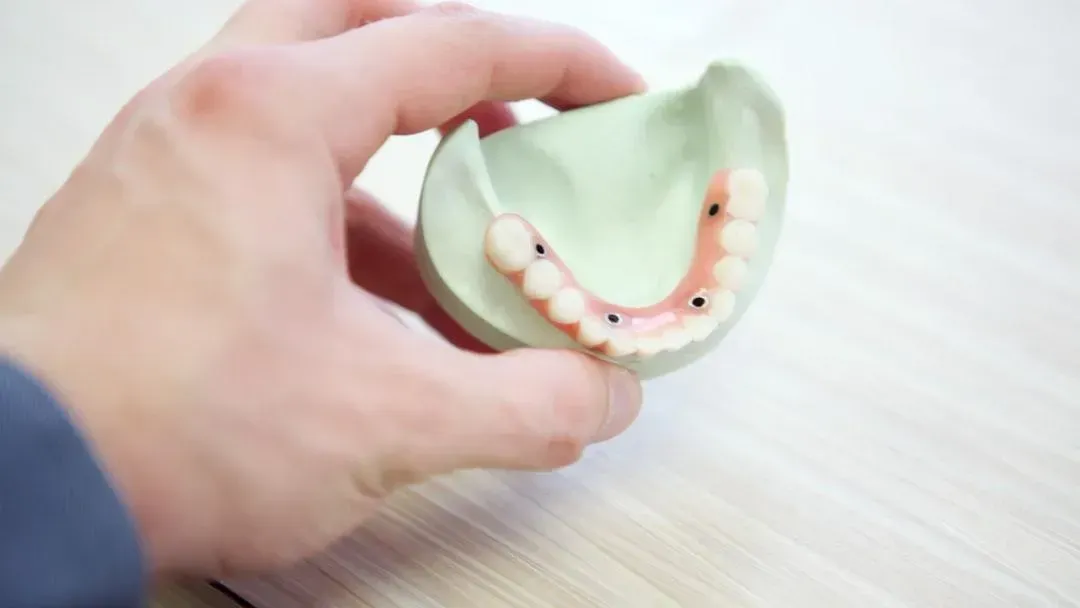
Structurally, a hybrid denture consists of a rigid titanium or zirconia framework hidden inside a pink acrylic resin base that mimics natural gum tissue. High-quality acrylic or porcelain teeth are secured to this framework. The entire unit is then screw-retained directly onto 4 to 6 dental implants.
Unlike traditional dentures, which sit loosely on your gums and rely on suction or messy adhesives, a hybrid denture does not budge. It can only be removed by a dentist during your routine professional cleanings. This makes it an incredibly popular option for those who want a permanent smile without the massive surgical footprint of replacing every single tooth individually. To learn more about how this differs from other full-arch options, you can read up on the differences between hybrid dentures and traditional dentures.
What Are Traditional Dental Implants?
Traditional dental implants are designed to mimic nature as closely as possible. If you are missing a single tooth, we place one titanium post and top it with an individual porcelain crown. If you are missing three or four teeth in a row, we might place two implants to support a multi-tooth bridge.
For a patient missing an entire arch of teeth, trying to replace them with individual traditional implants would require placing 10 to 12 implant posts and fabricating individual crowns for each one. While this provides the absolute highest level of cosmetic realism and mimics natural tooth spacing, it is rarely practical. It requires exceptional jawbone density, multiple complex surgeries, extensive bone grafting, and a significant financial investment.
Comparing Stability, Comfort, and Chewing Function

How do these options perform when you're sitting down to enjoy a steak, laughing with friends, or giving a presentation? The day-to-day experience of wearing a hybrid denture is vastly different from wearing traditional removable dentures, and it holds its own remarkably well against individual implants. If you are curious about the full spectrum of options, you can read our overview on the various Types of Dentures.
Stability and Chewing Power of hybrid dentures vs implants
Traditional removable dentures are notorious for slipping, clicking, and limiting your diet. Because they rest entirely on soft gum tissue, they only restore about 20% to 30% of your natural chewing efficiency.
Hybrid dentures and individual implants completely change the game. Because they are anchored directly into the jawbone, they transfer all chewing forces straight into your skeletal structure rather than your sensitive gums.
Bite Force: A fixed hybrid denture or a full-arch implant restoration can restore up to 90% of your natural biting force (often reaching 200 to 250 PSI). You can confidently eat apples, nuts, and steak without worrying about your teeth shifting.
Bone Preservation: By distributing bite forces evenly, both options prevent the localized bone resorption that makes traditional dentures fit poorly over time.
Restorative Space: Fabricating a successful hybrid denture requires a minimum of 12 to 15 mm of vertical restorative space (the distance from the implant platform to where your teeth meet). This space is necessary to ensure the titanium framework and acrylic base are thick enough to withstand heavy biting forces without fracturing.
Comfort and Daily Wear of hybrid dentures vs implants
Comfort is where the distinction between "fixed" and "removable" truly shines. Because hybrid dentures are screwed down tightly, they don't rub against your gums or cause painful sore spots.
Furthermore, traditional upper dentures must cover the entire roof of your mouth (the palate) to create suction. This barrier significantly dulls your sense of taste and can make speech sound muffled. Because hybrid dentures are held in place by implants, we can design them with a palate-free arch. Your palate remains completely open, instantly restoring your ability to taste foods, feel temperatures, and speak clearly.
During the design phase, we maintain a very slight mucosal contact beneath the hybrid denture. This small gap is carefully calibrated: it must be tight enough to prevent food from easily getting trapped and to maintain clear phonetics (avoiding "air leaks" that cause whistling when you speak), yet accessible enough to allow for daily cleaning.
Surgical Requirements and Bone Density Considerations
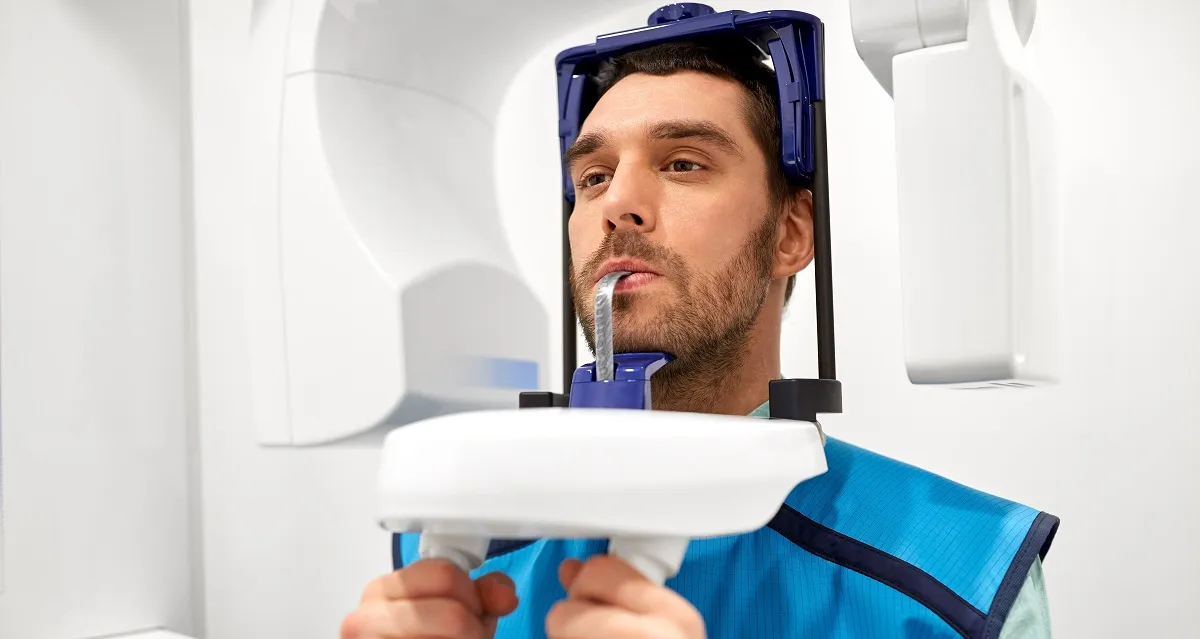
Before we can place a single implant, we must evaluate the foundation: your jawbone. When teeth are missing for years, the bone naturally degrades. Understanding how much bone you have left is the key to choosing between hybrid dentures vs implants. For a deeper dive into how full-arch surgical approaches compare to removable alternatives, check out our guide on Snap-In Dentures vs All on 4 Implants.
Implant Count and Placement Techniques
The number of implants required for your restoration dictates the complexity of your surgery:
Hybrid Dentures & All-on-4: These systems typically require only 4 to 6 implants per arch. By utilizing the All-on-4® or All-on-X technique, we can place the rear implants at a strategic angle (up to 45 degrees). This angling allows us to anchor the implants into the dense, strong bone at the front of your jaw, often completely bypassing the need for bone grafting.
Traditional Full-Arch Restorations: Replacing an entire arch with traditional individual implants or multi-unit bridges often requires 8 to 10 implants. This demands a massive amount of healthy bone across the entire jawline.
Branded Full-Arch Systems: Options like Hybridge typically utilize 5 to 6 implants per arch to support a specialized chrome-cobalt and PMMA bridge, offering a highly standardized, durable alternative for full-arch rehabilitation.
Solutions for Patients with Bone Loss
If you have experienced severe bone loss due to long-term tooth loss or periodontal disease, you aren't disqualified from getting a beautiful smile. However, your surgical path will look different:
Bone Grafting and Sinus Lifts: If you choose traditional individual implants, you will almost certainly need bone grafting or a sinus lift (for the upper jaw) to rebuild the bone structure. This adds several months to your overall treatment timeline.
The Hybrid Advantage in "Borderline Cases": Hybrid dentures are often the absolute best solution for borderline cases where patients have lost substantial bone and gum tissue. Because the hybrid prosthesis includes a custom-colored acrylic base, it replaces not just your teeth, but also the lost volume of your gums. This provides essential lip support, filling out your facial structure and smoothing out wrinkles around the mouth in a way that individual implants simply cannot do.
Cost, Longevity, and Maintenance: A Side-by-Side Comparison
When making a lifelong investment in your smile, you must weigh the upfront costs against the long-term value, durability, and daily effort required to keep your restoration healthy. To help you visualize these differences, let's look at how these treatments compare side-by-side:
Comparison Metric Hybrid Dentures All-on-4 / All-on-X (Fixed) Traditional Implants (Full Arch) Implant Count 4 to 6 4 to 6 8 to 12 Material Options Acrylic on Titanium / Zirconia Zirconia / PEEK / Porcelain Porcelain-fused-to-metal / Zirconia Upfront Cost (Per Arch) $15,000 – $35,000 $15,000 – $35,000 $30,000 – $50,000+ Prosthesis Lifespan 10 to 15 Years 15 to 20+ Years 20+ Years (Individual crowns) Implant Success Rate ~98% at 5 years ~98% at 5 years ~95% - 98% Daily Cleaning Floss threaders, water flosser Floss threaders, water flosser Standard brushing and flossing Professional Care Removal & cleaning every 6-12 months Removal & cleaning every 6-12 months Standard hygiene appointments
For a comprehensive breakdown of the financial aspects of these choices, you can read our detailed article on Dentures vs Implants Cost. You can also explore further clinical comparisons by reading this guide on Hybrid Dentures vs Dental Implants.
Upfront and Long-Term Cost Realities in 2026
As of June 2026, a fixed hybrid denture (such as an All-on-4 or All-on-6 restoration) typically ranges from $15,000 to $35,000 per arch at major clinics across the United States.
In contrast, replacing an entire mouth of teeth with individual traditional implants and crowns can easily exceed $40,000 to $60,000 per arch, as it requires far more surgical sites, individual custom crowns, and extensive bone grafting.
While hybrid dentures represent a larger upfront investment than removable overdentures (which typically cost $7,000 to $20,000 per arch), they offer a much lower long-term cost of ownership. Removable implant overdentures rely on plastic locator attachments or clips that wear out and must be replaced every 1 to 3 years. They also require laboratory relines every 2 to 5 years as your soft tissues shift. Because a hybrid denture is rigidly fixed, it does not experience this wear and tear.
Regarding insurance, most standard dental plans treat implants as cosmetic or elective, meaning they rarely cover the entire cost. However, they may cover portions of the preparatory work, such as extractions or the fabrication of the denture base. We highly recommend using your plan's annual maximums (which typically range from $1,000 to $2,000) strategically across calendar years to maximize your benefits.
Lifespan, Repairs, and Durability
While the titanium implant posts themselves are designed to last a lifetime (showing survival rates near 98% at five years), the prosthetic teeth attached to them will experience normal wear and tear:
Hybrid Denture Lifespan: The prosthesis itself typically lasts 10 to 15 years before it needs to be refurbished or replaced. The acrylic teeth can occasionally chip or wear down over time, especially if you grind your teeth. Fortunately, because the underlying titanium framework remains perfectly intact, repairing or replacing the acrylic portion is a straightforward process for our lab.
Zirconia and Porcelain Lifespan: High-end fixed restorations made of monolithic zirconia or porcelain-fused-to-metal are incredibly durable and rarely chip. They can easily last 20+ years, but they do carry a higher initial price tag.
Daily Hygiene and Professional Maintenance
Because hybrid dentures are fixed in place, you cannot take them out at night to soak. You must clean them directly in your mouth:
Daily Routine: You will need to brush your hybrid denture twice a day with a non-abrasive toothpaste. Because there is a tiny space between the prosthesis and your gums, using a water flosser (Waterpik) and specialized interdental brushes or super floss is essential to flush out food particles and plaque.
Professional Cleanings: Every 6 to 12 months, you must visit us for a professional maintenance appointment. During this visit, we will unscrew the hybrid denture, thoroughly clean and sanitize the prosthesis, inspect your gum tissue and implant health, check the tightness of your prosthetic screws, and screw the denture back into place.
Frequently Asked Questions About Full-Arch Restorations
Making the transition to a full-arch restoration is a life-changing journey. Here are some of the most common questions we hear from our Arvada patients.
Are hybrid dentures removable by the patient?
No. Hybrid dentures are classified as "fixed-detachable." They are securely screwed down onto the implant abutments and can only be safely removed by a qualified dental professional using specialized tools. This is actually a major benefit for many patients, as it eliminates the psychological anxiety of having your teeth slip out of place in public or having to place them in a glass of water on your nightstand.
How many implants are needed for a hybrid denture?
A hybrid denture typically requires 4 to 6 implants per arch. The exact number depends on whether we are restoring your upper or lower jaw. The upper jaw (maxilla) consists of softer, less dense bone and requires more support, so we often place 5 to 6 implants there. The lower jaw (mandible) is made of much denser bone, meaning we can frequently achieve exceptional stability with just 4 implants.
Can I transition from a removable overdenture to a fixed hybrid later?
Yes, in many cases this is entirely possible! Many patients begin their implant journey with a removable snap-in overdenture because it fits their immediate budget. If you decide later that you want the permanent, non-removable feel of a fixed hybrid, we can often convert your system.
Whether we can use your existing implants depends entirely on their original placement angles, their number, and whether you have maintained adequate bone volume over the years. We always recommend discussing your long-term goals during your initial consultation so we can place your implants in positions that keep your future options open.
Conclusion
At the end of the day, navigating the choice between hybrid dentures vs implants isn't about finding the "perfect" dental treatment — it's about finding the perfect treatment for you.
If you are missing isolated teeth and want to preserve your surrounding natural teeth, traditional implants are the gold standard. However, if you are facing severe tooth loss, currently struggle with failing teeth, or are tired of the daily hassle of loose removable dentures, a hybrid denture offers an unbeatable balance of stability, comfort, and life-changing aesthetics.
At Arvada Implants and Cosmetic Dentistry, we don't believe in assembly-line dental care. We pride ourselves on providing highly personalized, compassionate treatments. By utilizing state-of-the-art 3D CBCT scans and fully guided implant surgery, we design custom-tailored smiles in our partner labs to match your unique facial structure, budget, and lifestyle.
To explore our full range of solutions, we invite you to view Our Services. If you are ready to take the first step toward reclaiming a confident, beautiful, and fully functional smile, Schedule a consultation for full or partial dentures with our team in Arvada, Colorado today. We look forward to welcoming you to our dental family!