Smile Now, Pay Less Later with Budget-Friendly Dentures
The Real Cost of Missing Teeth — And How Low Cost False Teeth Can Help
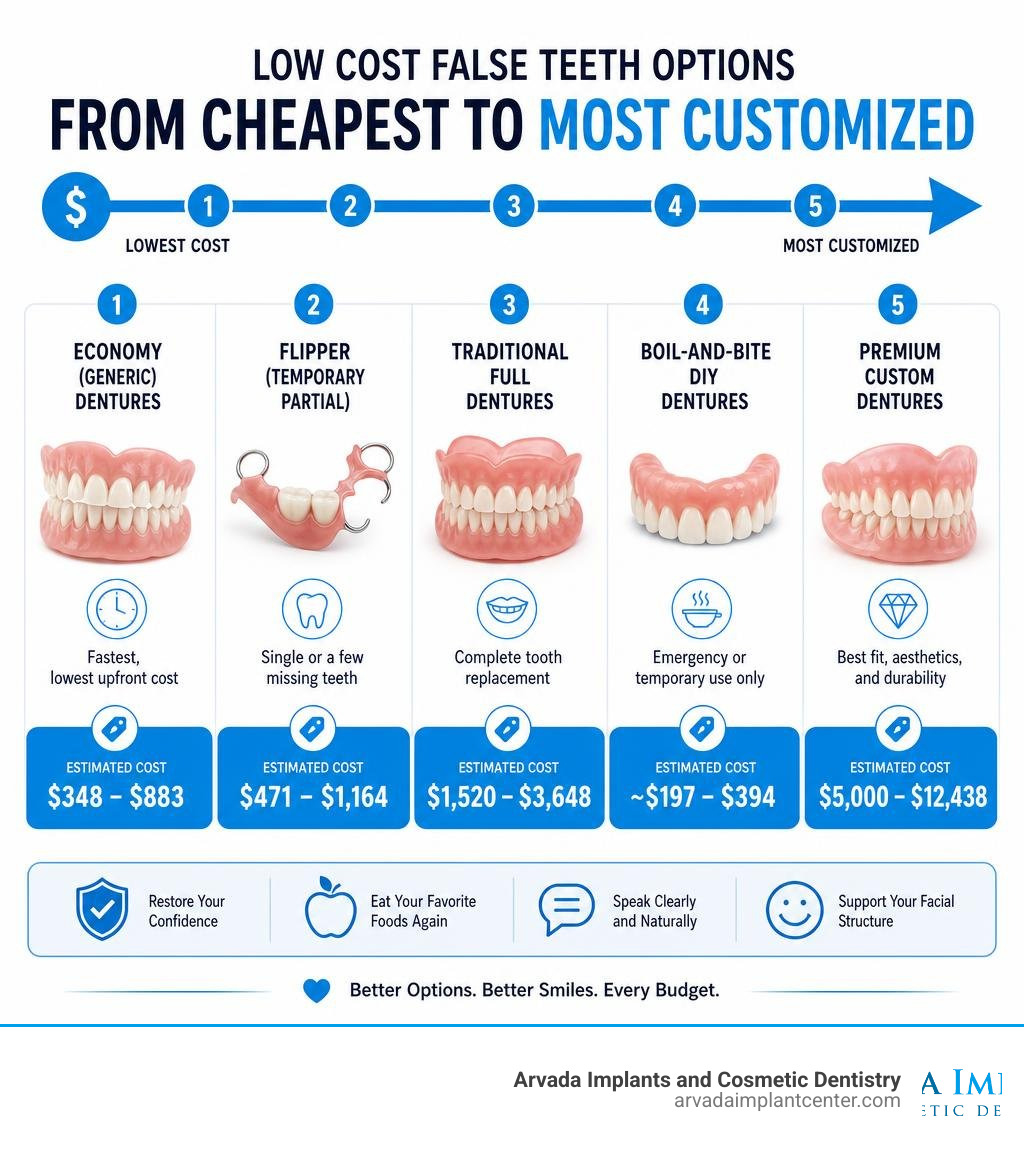
Low cost false teeth are more accessible than most people think — and if you're weighing your options, here's a quick breakdown of what's available right now:
Option Estimated Cost Best For Economy (generic) dentures $348 – $883 Fastest, lowest upfront cost Flipper (temporary partial) $471 – $1,164 Single or a few missing teeth Traditional full dentures $1,520 – $3,648 Complete tooth replacement Boil-and-bite DIY dentures ~$197 – $394 Emergency or temporary use only Premium custom dentures $5,000 – $12,438 Best fit, aesthetics, and durability
More than 36 million Americans are living without any natural teeth. For adults 75 and older, that number jumps to 1 in 4 people. Missing teeth aren't just a cosmetic issue — they affect how you eat, how you speak, and even how your face looks over time.
Without teeth, the jawbone loses the stimulation it needs to stay dense. This leads to bone resorption — where the jaw gradually shrinks — causing the sunken, aged facial appearance many people fear. Beyond looks, poor chewing ability can affect nutrition, and the emotional toll of hiding your smile is real.
The good news? You don't need to spend thousands to do something about it.
I'm Dr. Tariq Sawaqed, founder of Arvada Implants and Cosmetic Dentistry, and with over 20 years of experience in restorative and cosmetic dentistry, I've helped countless patients find low cost false teeth solutions that genuinely restore their confidence and function. In this guide, I'll walk you through every option — from economy dentures to flexible financing — so you can make the smartest choice for your smile and your budget.
What Are the Cheapest Types of Low Cost False Teeth?
When you begin searching for budget-friendly dental solutions, you will quickly discover that "dentures" is an umbrella term covering several distinct options. The right choice for you depends entirely on how many teeth you are missing, your oral health status, and your immediate financial flexibility.
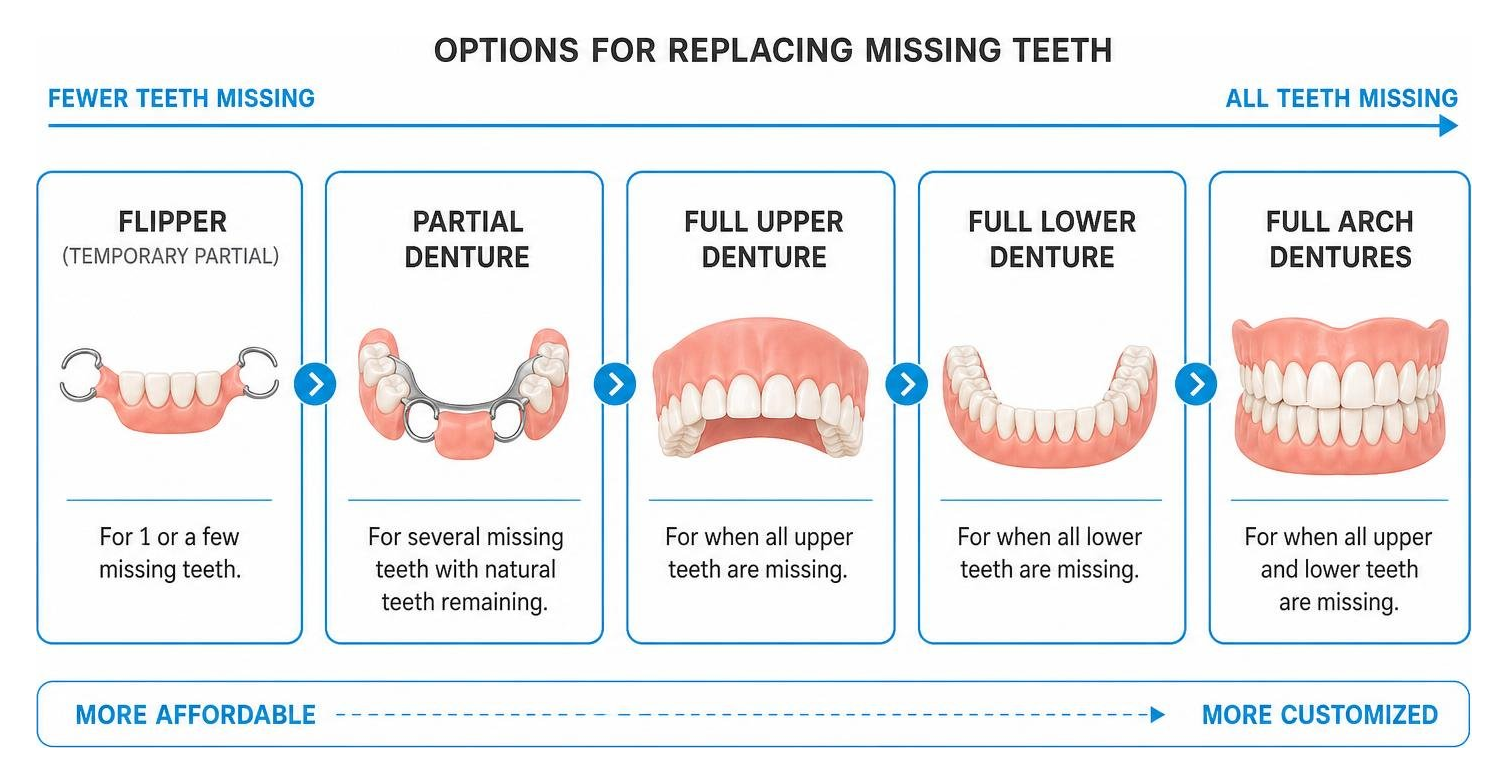
Generally, complete dentures are used when all teeth on either the upper or lower arch (or both) are missing. Partial dentures, on the other hand, are ideal if you still have healthy natural teeth remaining to anchor the prosthetic. If you want to explore the full spectrum of prosthetic designs, you can read more about the types of dentures available today.
The materials used to manufacture these prosthetics play a massive role in both their upfront price and long-term durability:
Acrylic Resin: This is the most common and cost-effective material. It is lightweight, exceptionally easy for a dentist to adjust, and mimics the appearance of natural pink gum tissue. However, acrylic wears down faster than porcelain and may require more frequent replacement.
Thermoplastic Materials: Often used for flexible partials, these materials are highly comfortable because they bend slightly to match the contours of your mouth. They do not require metal clasps, making them highly aesthetic, but they can be more prone to harbor bacteria if not cleaned meticulously.
Porcelain: While porcelain dentures look incredibly lifelike and resist daily wear beautifully, they are far more fragile than acrylic and are typically reserved for premium, higher-cost tiers.
Understanding Economy Options for Low Cost False Teeth
If your primary goal is to restore your smile as affordably as possible, economy dentures are the most budget-friendly path. The national average cost for low-cost economy dentures is $452, typically ranging from $348 to $883 per arch.
While the price tag is highly attractive, it is important to understand what you are buying. Economy dentures are often "generic" or semi-customized. Rather than being meticulously crafted over multiple appointments to match every tiny contour of your mouth, they are manufactured using pre-formed shapes.
Because they lack a precision custom fit, economy dentures typically require denture adhesives to stay securely in place, especially on the lower jaw. Furthermore, wearing traditional removable dentures of this tier can result in up to a 75% reduction in bite force compared to natural teeth. This means hard, raw, or fibrous foods (like a crisp tossed salad or a tough steak) can become quite challenging to chew.
Despite these limitations, many patients find them to be a life-changing starting point. To make sure you still look your best, we focus on achieving the most natural looking dentures possible within your budget, ensuring the tooth shade and shape match your facial structure.
Temporary Flippers and Partial Low Cost False Teeth
If you are only missing a few teeth, you do not need a full set of plates. Instead, you can explore partial solutions:
Flipper Dentures: A flipper is a lightweight, temporary partial denture that typically replaces one or two missing teeth. It is made of a thin acrylic base that snaps into place. Nationally, flipper dentures cost about $605 on average, ranging from $471 to $1,164. They are fantastic as a short-term cosmetic fix while you wait for a permanent solution, but they are not designed for heavy chewing over many years.
Clasp Partial Dentures: This is a more robust, long-term alternative that costs around $600 to $1,500. These partials use metal or rubberized clasps to anchor securely onto your remaining natural teeth. They distribute the forces of chewing across your existing teeth, which helps protect your gums.
For a deeper dive into how these options compare, check out our guide on full and partial dentures.
The Real Cost of Affordable Dentures
When planning your budget, it is vital to look beyond the base price of the denture itself. The total out-of-pocket cost is influenced by where you live, the health of your mouth, and the specific clinic you choose.
Geographic location plays a surprisingly large role. For example, traditional dentures in Colorado average $1,982 per arch, which is slightly higher than the national average but far more affordable than in major coastal metropolitan areas.
To help you visualize where your money goes, we have broken down the typical financial investment of transitioning to dentures versus other alternatives. If you are comparing different tooth-replacement pathways, you can read our comprehensive breakdown on dentures vs implants cost.
Average Price Ranges and Tiers
Dentures are generally categorized into distinct tiers, each reflecting a different balance of material quality, customization, and warranty protection:
Economy/Basic Tier ($348 – $883 per arch): Built using standard acrylics and pre-fabricated shapes. These often come with a short warranty (typically 6 months to 1 year) and are designed for rapid, low-cost delivery.
Classic/Mid-Range Tier ($1,000 – $2,000 per arch): Offers a higher level of customization. The dentist takes detailed impressions of your bite, and the teeth are arranged to look more natural. These typically include a 1-to-2-year warranty against cracking or breaking.
Premium/Custom Tier ($5,000 – $12,438 for a full set): These use highly durable, stain-resistant materials and are hand-crafted to achieve maximum realism. They often feature multi-tonal gum shading, premium impact-resistant resins, and extended warranties of 5 to 7 years.
Hidden Fees and Additional Dental Procedures
When you see an advertisement for a "$499 denture," that price almost always refers strictly to the prosthetic plate itself. In the real world, your mouth must be prepared to receive the denture. These preparatory steps carry their own costs:
Diagnostic Exams and X-rays: A comprehensive initial exam and full-mouth X-rays are required to evaluate your bone density and joint health. This typically costs $150 to $253 without insurance.
Simple Extractions: If you have remaining teeth that are decayed or broken beyond repair, they must be removed. A simple extraction averages $177 per tooth.
Surgical Extractions: If a tooth is broken at the gumline or impacted, it requires a surgical extraction, which averages $363 per tooth.
Immediate/Temporary Dentures: Once teeth are extracted, your gums and jawbone will swell, shrink, and change shape over a six-month healing period. You cannot wear your permanent denture during this time. Many patients purchase a temporary "immediate" denture to wear during this transition so they never have to go out in public without teeth.
Relines: As your jaw heals and bone resorption occurs, your dentures will lose their tight fit. You will need professional "relines" (adding material to the underside of the denture) to restore suction.
Comparing Your Options: Economy vs. Premium Dentures
To help you decide which tier aligns best with your lifestyle and financial goals, we have compiled a direct comparison of the key features:
Feature Economy Dentures Mid-Range / Classic Premium Custom Dentures Average Cost (per arch) $452 $1,175 $3,250+ Primary Material Standard Acrylic Premium Impact Acrylic High-Impact Resin / Porcelain Customization Low (pre-formed shapes) Moderate (custom mold) High (fully personalized fit & aesthetics) Stain Resistance Basic Moderate Excellent Bite Force Restoration ~25% of natural force ~30% - 40% of natural force ~40% - 50% of natural force Typical Lifespan 2 to 5 years 5 to 7 years 7 to 10+ years Warranty 6 months to 1 year 1 to 2 years 5 to 7 years
While economy options are excellent for immediate savings, premium dentures offer a more comfortable daily experience, look indistinguishable from natural teeth, and boast a much longer lifespan. At Arvada Implants and Cosmetic Dentistry, we work closely with our patients to find the perfect middle ground, ensuring you receive the highest possible quality for your budget.
Financing and Insurance Coverage for Dentures
Paying for dental care upfront can feel overwhelming, but you do not have to let dental anxiety or financial stress keep you from smiling. There are numerous pathways to make your treatment plan highly manageable.

Many patients are surprised to learn that structured payment options can bring the monthly cost of a beautiful smile down to the price of a daily cup of coffee. To explore how we structure these packages, you can read our guide on affordable dentures and dental implants.
Does Dental Insurance or Medicare Cover the Cost?
Navigating insurance can be tricky, but here is what you need to know about the major coverage types:
Private Dental Insurance: Most private dental insurance plans cover dentures as a "major restorative procedure." Typically, they will pay 50% of the cost, leaving you to cover the remaining 50%. However, keep an eye on your plan's annual maximum benefit, which is often capped between $1,000 and $1,500. If your treatment exceeds this limit, you must pay the rest out-of-pocket.
Basic Medicare: Original Medicare (Parts A and B) does not cover dentures or routine dental care.
Medicare Advantage (Part C): Many Medicare Advantage plans do offer dental benefits, which may include partial coverage for exams, extractions, and dentures. Be sure to call your provider directly to verify your specific benefits.
Medicaid: In Colorado, adult Medicaid does offer dental benefits, but coverage limits and provider participation vary. We can help you determine what is covered under your current plan.
Flexible Payment Plans and Dental Savings Memberships
If you do not have traditional dental insurance, or if your insurance does not cover the full cost of your treatment, you still have excellent options:
Third-Party Financing: Companies like CareCredit allow you to split your treatment cost into affordable monthly payments. Many of these programs offer promotional 0% APR financing for 6, 12, or 18 months, allowing you to pay for your smile over time without paying a penny in interest.
In-House Dental Savings Plans: Many modern dental offices offer in-house membership plans. For a small annual fee, these plans grant you access to free preventative care (like cleanings and X-rays) and significant discounts (often 10% to 20% off) on major procedures like dentures.
Flexible Spending Accounts (FSA) and Health Savings Accounts (HSA): You can use pre-tax dollars from your FSA or HSA to pay for dentures, extractions, and adjustments, saving you money on your tax bill.
For more tips on finding affordable dental care, you can read our article on cheap dental implants near me.
Frequently Asked Questions About Budget Dentures
How long do cheap dentures typically last?
On average, economy or cheap dentures last between 2 to 5 years. Over time, the acrylic teeth will naturally wear down from chewing, and the pink base can become brittle.
Furthermore, because your jawbone naturally shrinks over time without natural teeth, the denture will gradually lose its tight fit. Even the highest-quality dentures require professional relines every 1 to 2 years to maintain proper suction and prevent painful sore spots.
Can I upgrade budget dentures to dental implants later?
Absolutely! This is a very common and highly recommended pathway for patients on a budget. You can start with an affordable, removable economy denture to restore your smile and chewing function immediately.
Later, as your budget allows, you can transition to implant-supported overdentures (often called "snap-on" dentures). These utilize titanium implant posts placed in the jawbone to lock your dentures securely in place. This eliminates the need for messy adhesives, prevents your dentures from slipping when you speak, and stops bone resorption by stimulating the jaw.
To learn more about how this transition works, read our guides on dentures with dental implants and cheap permanent dental implants.
Where can I find affordable dentures near me?
If you live in the Arvada or Colorado Springs area, there are several local resources you can leverage:
Arvada Implants and Cosmetic Dentistry: We specialize in creating custom-fit, highly durable prosthetics tailored to your specific budget. By utilizing advanced technology and personalized treatment planning, we eliminate unnecessary overhead and pass those savings directly to you.
Dental School Clinics: Institutions like the University of Colorado School of Dental Medicine offer dental services performed by students under the direct supervision of licensed, experienced faculty dentists. Because it is an educational environment, fees are often significantly lower than traditional private practices.
Community Health Centers: Local public health clinics sometimes offer sliding-scale fees based on your household income.
Conclusion
At Arvada Implants and Cosmetic Dentistry, we firmly believe that financial constraints should never stand between you and a healthy, confident smile. Whether you are looking for a simple, budget-friendly economy partial or want to explore advanced implant-supported options, we are here to help you navigate your journey without judgment or pressure.
We pride ourselves on providing highly personalized treatment plans, utilizing custom lab creations to design a smile that is uniquely yours. Ready to take the first step toward reclaiming your confidence, your favorite foods, and your smile? Schedule a consultation for full and partial dentures with us today!