Dentures vs. Implants: Which One Should You Pick?
What Tooth Loss Really Costs You — and How to Fix It
When weighing dentures vs implants, the right choice depends on your budget, bone health, and how much you want your replacement teeth to feel like the real thing.
Here's a quick comparison to help you decide:
Factor Dentures Dental Implants Upfront cost Lower ($1,000–$3,000/arch) Higher ($1,600–$2,200+/tooth) Lifespan 5–7 years before replacement 20+ years, often lifetime Chewing power 10–20% of natural Up to 98% of natural Bone preservation No — bone loss continues Yes — stimulates jawbone Surgery required No Yes Maintenance Daily removal and soaking Brush and floss like natural teeth Best for Budget-conscious, non-surgical patients Long-term function and health
Missing teeth affect more than your smile. They change how you eat, how you speak, and how you feel walking into a room. Over time, they can also cause your jawbone to shrink — reshaping your face in ways that are hard to reverse. For the more than 36 million Americans missing all their natural teeth, finding the right solution isn't just a dental decision. It's a quality-of-life decision.
The good news? In 2026, you have more options than ever — from traditional removable dentures to permanent implants to smart hybrid solutions in between.
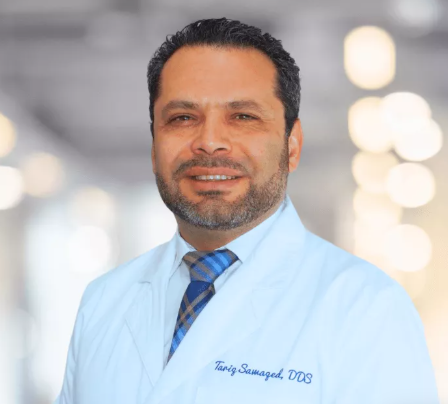
I'm Dr. Tariq Sawaqed, CEO of Arvada Implants and Cosmetic Dentistry, and with over 20 years of clinical experience helping patients navigate the dentures vs implants decision, I've guided thousands of people toward smile restorations that fit their lives, budgets, and long-term health goals. In this guide, I'll walk you through everything you need to make a confident, informed choice.
Understanding the Core Differences: Dentures vs Implants
To understand the debate of dentures vs implants, we have to look under the surface—literally.
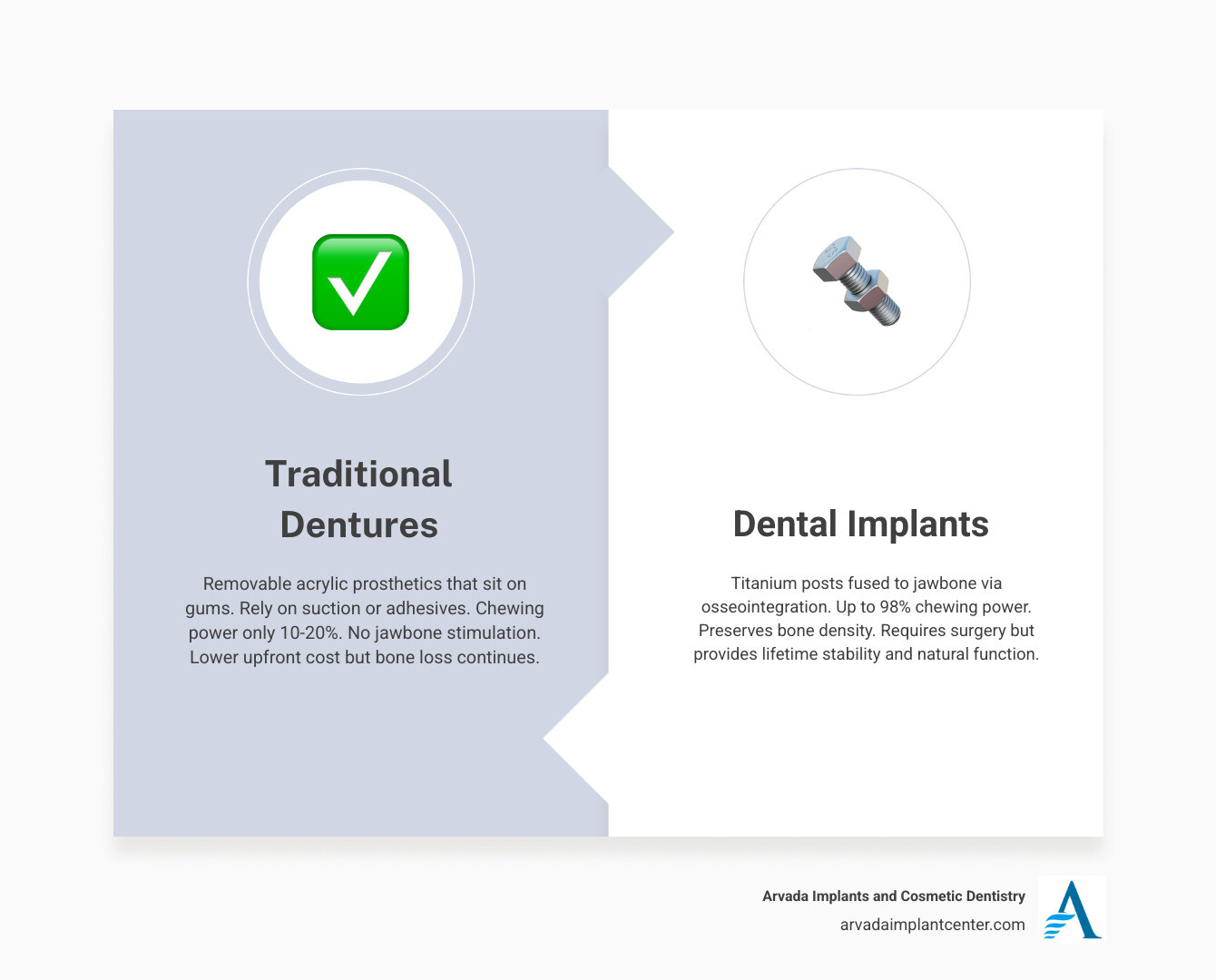
Traditional dentures are removable prosthetics. They are usually made of an acrylic base that mimics gum tissue, with porcelain or plastic teeth attached. They sit on top of your gums and rely on natural suction, or sometimes dental adhesives, to stay in place. While they have helped millions of people regain their smiles, they are essentially "sitting" on the problem rather than fixing the foundation.
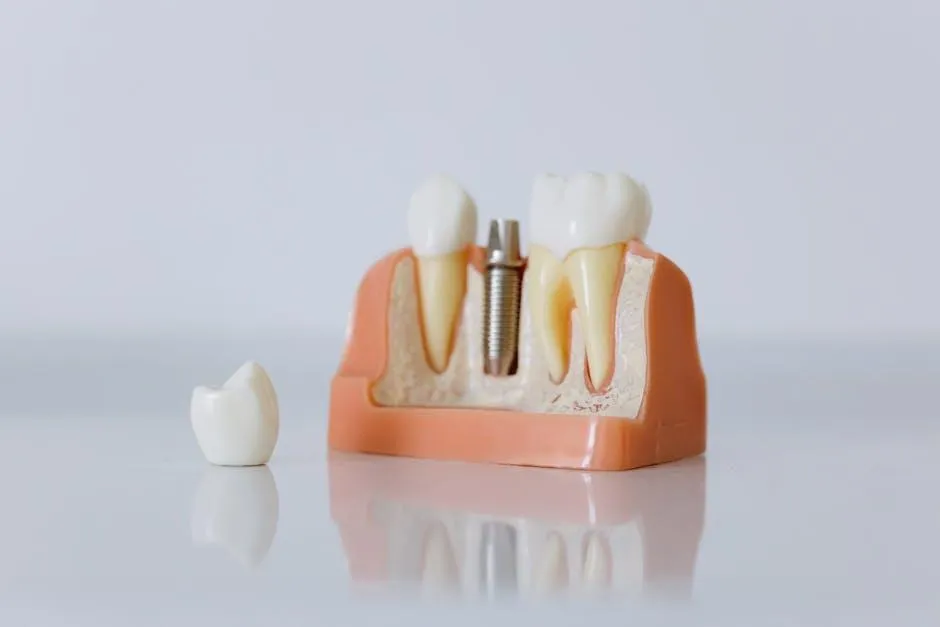
Dental implants, on the other hand, are a marvel of modern bio-engineering. An implant consists of a small titanium post that acts as a replacement for your tooth root. Through a biological process called osseointegration, your jawbone actually fuses with the titanium post over a few months. This creates a rock-solid foundation for a crown, bridge, or even a full set of teeth.
The fundamental difference? Dentures are a "removable" solution that rests on the tissue, while implants are a "permanent" solution that becomes part of your body. For a deeper dive into these options, check out this guide on Dentures vs. Implants: How to Choose.
If you are leaning toward the stability of a permanent solution, you can find More info about dental implants here.
Functionality of Dentures vs Implants
Let’s talk about dinner. One of the biggest complaints we hear from denture wearers is the inability to eat the foods they love. Because traditional dentures only provide about 10–20% of your natural chewing power, steak, apples, and corn on the cob often become off-limits.
Dental implants are a game-changer here, restoring up to 98% of natural chewing power. Because they are anchored into the bone, you don't have to worry about them shifting or clicking while you eat.
Speech is another factor. Traditional upper dentures often feature a plate that covers the roof of your mouth (the palate). This can muffle your speech and, perhaps more tragically, dull your sense of taste. Since many of our taste buds are located on the palate, covering them up makes food taste bland. Implants don't require this palate coverage, allowing you to speak clearly and enjoy the full flavor of your meals.
If you’re currently struggling with a "floating" lower denture or a clicking upper, you might want More info about fixing loose dentures to see how we can stabilize your smile.
Maintenance and Daily Care
When it comes to daily life, dentures vs implants offer very different routines.
Dentures require a specific nightly ritual. You have to remove them, brush them with a non-abrasive cleaner (regular toothpaste is often too harsh for acrylic), and soak them overnight in a specialized solution. This keeps them moist so they don't lose their shape and helps kill bacteria that can cause "denture breath" or gum sores.
Implants are much simpler. You treat them exactly like natural teeth. You brush twice a day, floss daily, and visit us for regular professional cleanings. There’s no "taking your teeth out" at night or soaking them on the nightstand. For many of our Arvada patients, this return to a "normal" routine is one of the biggest psychological benefits of implants.
Curious about the different styles of removable options? Read More info about types of dentures to see which might fit your current situation.
Chewing Power and Jawbone Health: Why the Choice Matters
This is the part of the conversation that most people don't realize until it's too late: the health of your jawbone.
Your jawbone needs stimulation to stay healthy. In a natural mouth, every time you chew, the roots of your teeth send mechanical signals into the bone, telling it to stay strong and dense. When you lose teeth, that stimulation stops.
Traditional dentures do not provide this stimulation. In fact, the pressure of a denture sitting on the gums can actually accelerate bone loss. This is why dentures that fit perfectly today will feel loose in two or three years—your jawbone is literally shrinking away from the prosthetic. This leads to the "sunken" facial appearance often associated with aging.
Dental implants are the only tooth replacement option that preserves and even stimulates bone growth. Because of osseointegration, the implant acts like a natural root. A 2026 large-scale study of over 158,000 implants recorded a clinical success rate of 97.83%, with 20-year survival rates staying above 90%. This means implants aren't just a cosmetic fix; they are a long-term health investment.
For those in Colorado looking for a breakdown of these health impacts, this Dentures vs Dental Implants: Pros, Cons & Cost guide offers great local insights. If you have already lost several teeth and are worried about your facial structure, get More info about multiple missing teeth.
Cost Analysis: Upfront Savings vs. Long-Term Value
Let’s address the elephant in the room: the price tag. When comparing dentures vs implants, dentures almost always win on the upfront cost.
Expense Category Traditional Dentures Dental Implants (Single) All-on-4 (Full Arch) Upfront Cost ~$1,600 per arch $1,600 – $2,200+ $15,000 – $25,000+ Lifespan 5–7 years 20+ years 20+ years Hidden Costs Adhesives, relines, replacements Virtually none Periodic professional cleaning 20-Year Total High (due to 3-4 replacements) Low (one-time investment) Moderate to High
While a complete set of upper dentures might cost around $1,600 initially, the American Dental Association (ADA) recommends replacing them every 5–7 years. When you factor in the cost of professional relines every few years, cleaning solutions, and adhesives, the lifetime cost of dentures starts to climb.
Implants have a higher entry price, but they are designed to be a one-time investment. Over a 20-year period, many patients find that implants are actually more economical because they don't require constant maintenance and replacement.
If you’re worried about the cost of a full set of implants, you might look into More info about clip-in denture cost for a middle-ground price point. And if you're hunting for deals in the Arvada area, we have More info about cheap dental implants near me to help you understand what to look for (and what to avoid).
Hybrid Solutions: Snap-in Dentures vs All-on-4 Implants
What if you want the stability of implants but don't want to pay for a dozen individual posts? This is where hybrid solutions come in.
Snap-in Dentures (Implant-Supported Dentures) These are dentures that "snap" onto two to four implant posts. They are still removable at night, but they won't slip or slide while you're talking or eating. They allow patients to maintain about 50% of their natural chewing function—a massive upgrade from the 10-20% offered by traditional dentures. You can find out more about Implant-Supported Dentures | Dentist in Arvada, CO here.
All-on-4 Implants (Fixed Bridges) This is the "gold standard" for full-mouth restoration. We place four (sometimes six) implants in strategic locations where your bone is densest. A permanent bridge—often made of high-quality zirconia—is then screwed onto those implants. It does not come out. This system restores over 90% of chewing function and looks indistinguishable from natural teeth. Check out More info about All-on-4 to see how it works.
Comparing Hybrid Dentures vs Implants
Choosing between a snap-in and a fixed All-on-4 bridge usually comes down to your lifestyle goals.
Snap-in dentures are more affordable and easier to clean because you can take them out. However, they still have a bit of a "denture feel" and may still involve a palate plate on the upper jaw.
All-on-4 is a "fixed" solution. It is palate-free, meaning you get your taste and speech back completely. It’s also incredibly stable. For a side-by-side breakdown, read More info about snap-in dentures vs All-on-4 implants.
If you're curious about the mechanics, we have More info about how snap-in dentures work that explains the "locator" attachments and how they keep your teeth secure.
How to Choose the Right Path for Your Smile
So, how do you decide on dentures vs implants? It isn't just about the money; it’s about your biology and your goals.
Bone Density: If you’ve been missing teeth for a long time, your jawbone may have thinned. Implants need a certain amount of bone to "grip" onto. If you don't have enough, you might need a bone graft first. Dentures don't require surgery or specific bone density.
Overall Health: Conditions like uncontrolled diabetes or heavy smoking can slow down the healing process (osseointegration). We always screen our Arvada patients to ensure they are healthy enough for a successful surgery.
Timeline: Dentures can often be made in a few weeks. Implants are a journey—it can take 3 to 6 months for the bone to heal before the final teeth are attached.
Lifestyle: Do you want to "set it and forget it"? Implants are for you. Are you looking for the most non-invasive, quickest fix? Dentures might be the way to go.
For those living locally, we offer More info about dental implants in Arvada to help you understand the specific process at our clinic.
Frequently Asked Questions about Tooth Replacement
Can I switch from traditional dentures to implants later?
Absolutely! In fact, many of our patients start with dentures and "upgrade" to implants once they realize how much they miss eating their favorite foods. The only caveat is that the longer you wear dentures, the more bone you lose. If you wait 10 years to switch, you are much more likely to need a bone graft before the implants can be placed.
What is the recovery time for dental implant surgery?
Most patients are surprised by how easy the recovery is. You’ll likely feel some soreness for 3–5 days, which is usually managed with over-the-counter pain relief. However, the "under the hood" healing (the bone fusing to the implant) takes 3 to 6 months. During this time, you'll wear a temporary set of teeth so you’re never without a smile. Get More info about All-on-4 recovery time for a detailed timeline.
Are there alternatives like dental bridges or flippers?
Yes. If you are only missing one or two teeth, a dental bridge or a "flipper" (a temporary partial denture) might work. A bridge is fixed but requires us to shave down the healthy teeth next to the gap to act as anchors. Implants are generally preferred because they don't "sacrifice" healthy teeth. If you're just dealing with a single gap, check out More info about one missing tooth.
Conclusion
At Arvada Implants and Cosmetic Dentistry, we believe everyone deserves a smile that makes them feel like themselves again. Whether you choose the tried-and-true affordability of dentures or the life-changing permanence of dental implants, our goal is to provide a personalized treatment plan that fits your life.
We take pride in our custom lab creations, ensuring that your new teeth don't just look "good"—they look like your teeth. From affordable smile makeovers to complex full-mouth reconstructions, we are here to guide you through every step of the dentures vs implants journey.
Ready to see what's possible? Get More info about full and partial dentures and schedule your consultation with us today. Let's get you back to smiling, speaking, and eating with total confidence!