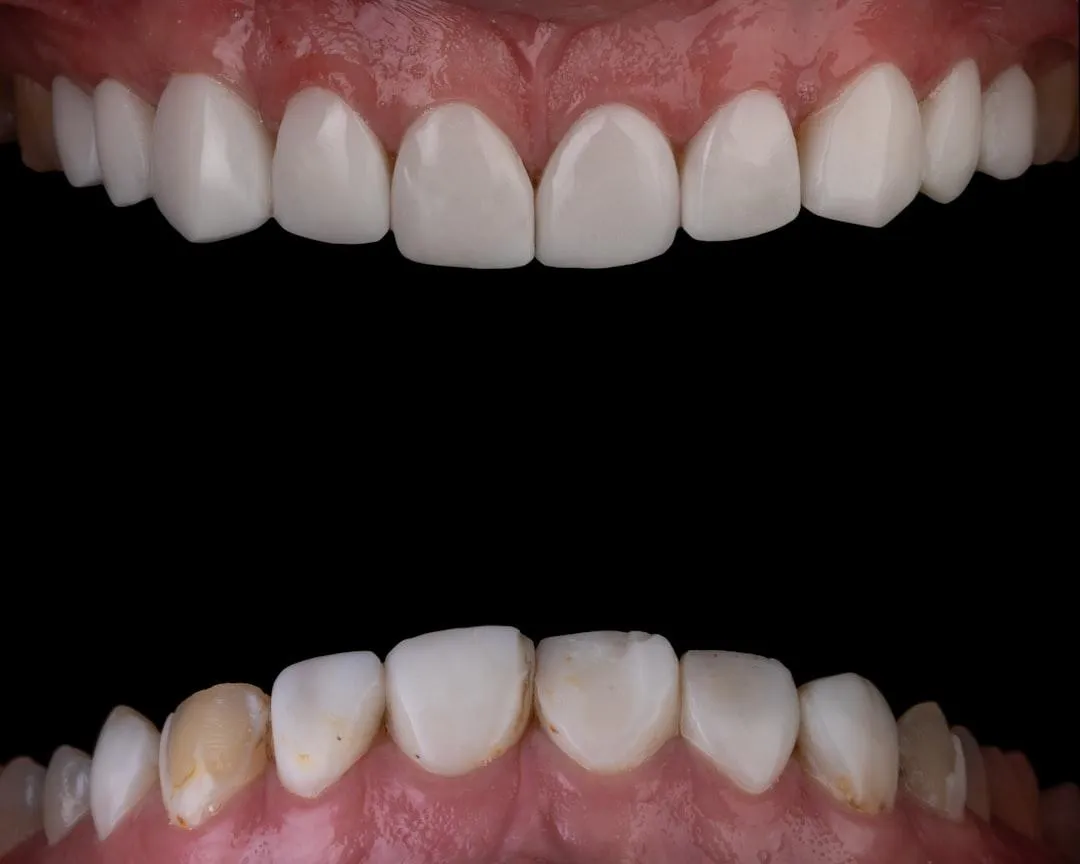
Spitting Image: Your Guide to Dentures That Actually Look Real
Why So Many People Are Searching for Natural Look Dentures
If you're exploring natural look dentures, here's a quick answer before we dive deeper:
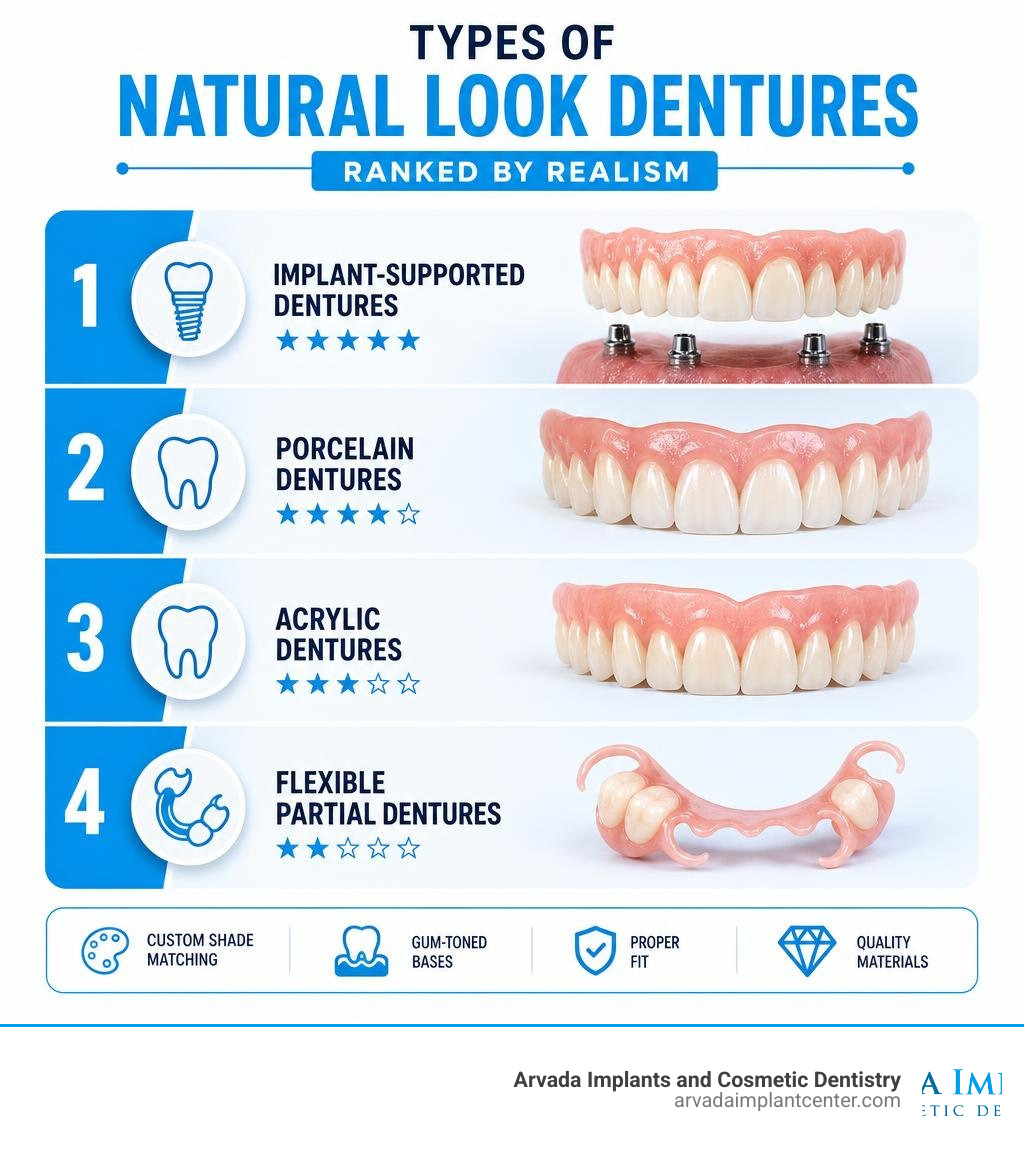
The most natural-looking denture options in 2026, ranked:
Implant-supported dentures — anchored to the jawbone, zero slipping, best function and aesthetics
Porcelain full or partial dentures — closely mimic enamel translucency and natural tooth color
High-quality acrylic dentures — custom-shaded and fitted for a lifelike result at a lower cost
Flexible partial dentures — blend with gum tissue for a seamless, comfortable fit
The key factors that make any denture look real are: custom shade matching, gum-toned bases, proper fit, and quality materials.
Over 120 million Americans are missing at least one tooth. And the number one fear most people have — beyond cost or discomfort — is looking obviously like they're wearing dentures.
The good news? That fear is becoming outdated.
Modern dentures look nothing like the bulky, too-white, "fake teeth" of decades past. Today's options use advanced materials, digital design, and skilled craftsmanship to create smiles that are genuinely hard to tell apart from natural teeth.
But not all dentures are created equal. The difference between a denture that looks real and one that looks fake often comes down to three things: the materials used, the level of customization, and the skill of your dental team.
This guide walks you through every major option so you can compare them clearly and make a confident decision.
I'm Dr. Tariq Sawaqed, cosmetic and implant dentist and founder of Arvada Implants and Cosmetic Dentistry, with over 20 years of experience helping patients achieve natural look dentures through advanced digital dentistry and personalized smile design. I'll be your guide through everything you need to know to find the right fit for your smile and your budget.
What Makes Modern Natural Look Dentures Look Real?
To understand why old-school dentures often looked like a set of plastic wind-up chattering teeth, we have to look at how light interacts with our mouths.
Natural teeth are not solid, opaque white blocks. They are highly complex structures. Real tooth enamel is translucent, meaning light passes through the outer layer and reflects off the deeper dentin layer. Furthermore, human gums are not a uniform, flat shade of pink; they feature a delicate map of gradients, tiny blood vessels, and contouring where the tissue meets the tooth.
Older manufacturing processes ignored these details, producing uniform "piano key" teeth anchored in flat, monochromatic pink plastic.
Modern natural look dentures achieve realism by replicating these subtle organic details:
Enamel Translucency: High-end materials allow light to penetrate and scatter just like natural enamel.
Multi-Tonal Gum Bases: Instead of a single pink hue, modern bases are layered with various shades, textures, and even microscopic fibers that mimic real capillaries.
Anatomical Contouring: The transition zone where the artificial tooth meets the synthetic gum line is carefully sculpted, preventing the flat "plastic plate" look.
Facial Support Restoration: Properly designed dentures do not just replace teeth; they support your lips and cheeks, preventing the sunken facial appearance often associated with tooth loss.
By focusing on these biological nuances, we can create restorations that blend seamlessly with your remaining features. To explore how these design factors come together, you can Learn more about natural looking dentures.
Choosing the Right Materials for Natural Look Dentures
The foundation of any realistic restoration lies in the materials selected. Today, we primarily work with three classes of materials, each offering unique benefits:
Porcelain: Historically the gold standard for realism, porcelain is highly valued for its natural luster and resistance to staining. It reflects light almost identically to real enamel. However, porcelain teeth are heavier and can be more brittle than modern alternatives, making them highly aesthetic but requiring careful handling.
Acrylic Resin: Premium, high-impact acrylic resins are the most common materials used today. They are incredibly lightweight, highly customizable, and bond chemically to the denture base. While older acrylics wore down quickly, 2026-era premium resins offer exceptional durability and stain resistance while maintaining a beautiful, lifelike polish.
Composite Materials: Dental composites offer a middle ground, balancing the strength of porcelain with the fracture resistance and lightweight nature of acrylic. They can be highly characterized by a technician to match existing teeth.
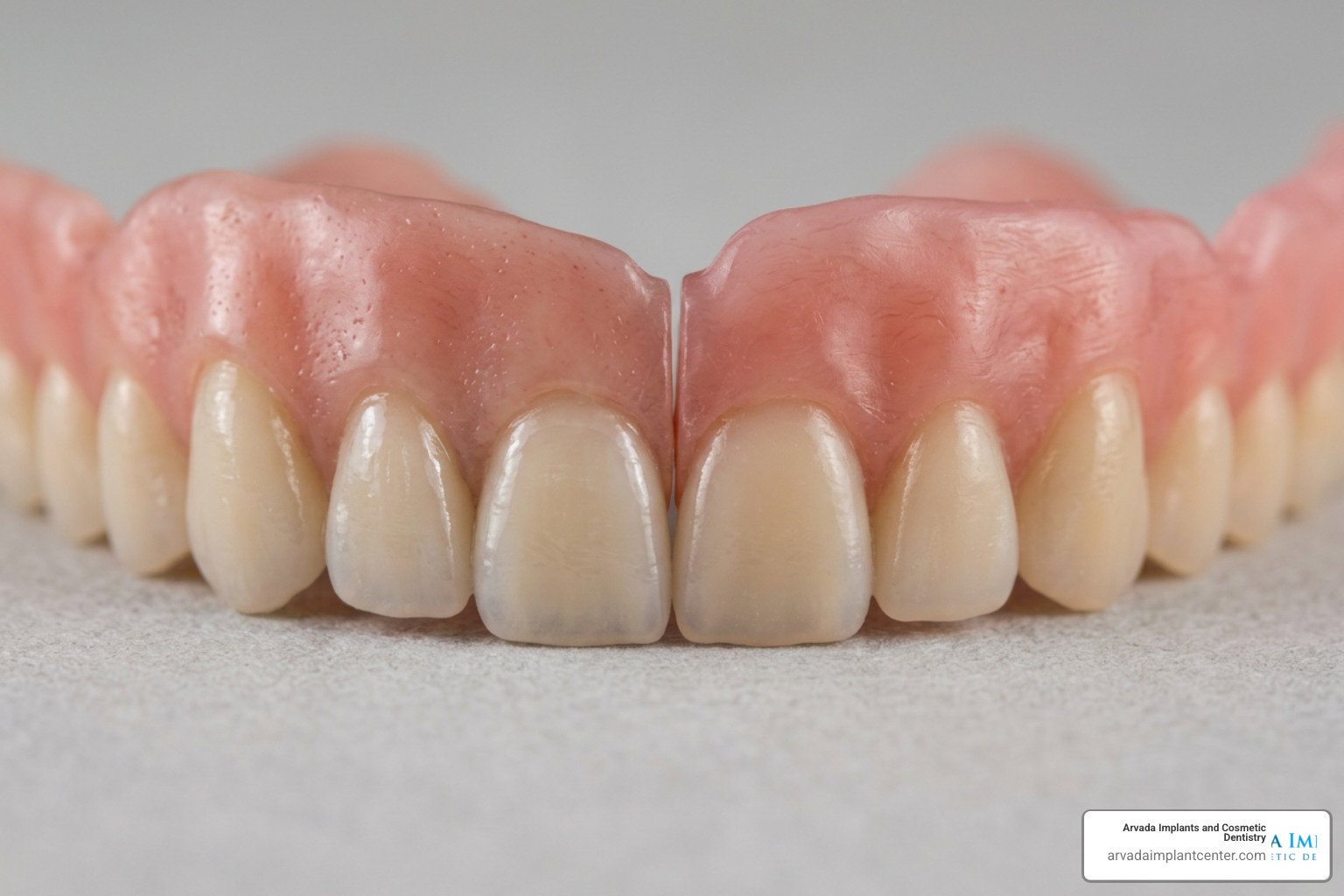
When selecting materials, we assess your bite strength, lifestyle, and aesthetic goals to find the perfect match. To dive deeper into how these materials perform, Read about the most realistic full and partial dentures.
Customization and Fit: The Secret to Natural Look Dentures
Have you ever noticed that the most attractive natural smiles are rarely perfectly symmetrical? Nature loves subtle imperfections. When a denture is designed with perfectly straight, identical teeth, it instantly triggers the "uncanny valley" effect—our brains recognize that something is artificial.
True customization involves designing subtle, deliberate variations into your smile:
Micro-Asymmetries: Slightly rotating a lateral incisor or introducing minor variations in tooth length mimics natural development.
Custom Shade Matching: We utilize over 12 distinct tooth shades and multiple gum variations to match your age, skin tone, and remaining teeth.
Proper Lip Support: If a denture is too thin, your lips will collapse inward; if it is too thick, you will look like you are holding a golf ball in your mouth. A precise physical fit ensures your natural facial structure is fully supported.
Without a highly customized fit, even the most expensive materials will look out of place. To see how precise measurements translate into a beautiful smile, Discover the best dentures for precise fit and natural look.
Comparing the Main Types of Lifelike Dentures
Depending on how many teeth you are replacing and the health of your underlying jawbone, we categorize natural look dentures into three primary types.
To help you compare your options at a glance, we have compiled this breakdown:
Feature Traditional Full Dentures Custom Partial Dentures Implant-Supported Dentures Best Suited For Complete tooth loss (whole arch) Missing several teeth in an arch Complete tooth loss with stable bone Retention Method Natural suction & mild adhesives Metal clasps or flexible pink clasps Titanium implants fused to jawbone Realism Rating High (when custom-designed) Exceptional (blends with real teeth) Unmatched (looks and behaves like real teeth) Chewing Efficiency ~20% to 30% of natural teeth ~45% to 60% of natural teeth Up to 70%+ of natural teeth Jawbone Preservation None (bone resorbs over time) Minimal (only around natural teeth) Excellent (implants stimulate bone) Lifespan 5 to 10 years (requires relines) 5 to 10 years 15+ years (implants can last a lifetime)
Selecting the right configuration is highly personal. To explore these options in greater detail, Explore the complete guide to full and partial dentures in 2026.
Traditional Full and Partial Dentures
Traditional full dentures replace an entire upper or lower arch. Upper dentures utilize natural suction against the palate to stay in place, while lower dentures rely on the natural ridge of the jaw and muscle control of your tongue and cheeks.
Partial dentures are designed to fill in gaps when you still have healthy natural teeth remaining. Historically, partials were held in place by visible, metallic clasps that could give away your secret when you laughed or smiled.
Today, we utilize modern alternatives to keep partials invisible:
Aesthetic Clasps: Made from tooth-colored or gum-shaded materials that blend into the background.
Flexible Partials: Crafted from lightweight, biocompatible thermoplastic materials. These bases are semi-translucent, allowing your natural gum tissue to show through, creating an incredibly seamless blend.
Whether you are looking for Full & Partial Dentures in Arvada, Colorado or general cosmetic restorations, avoiding metal frameworks in your smile zone is the fastest way to keep your dental work private. For a comprehensive look at modern partial designs, Check out the ultimate flexible partial dentures guide.
Implant-Supported Dentures: The Gold Standard for Realism
If you want the absolute highest level of realism, stability, and comfort, implant-supported dentures are the gold standard.
Unlike traditional dentures that sit on top of your gums, implant-supported systems are anchored directly to your jawbone using titanium posts. These posts act as artificial tooth roots, fusing with your bone in a process called osseointegration.

Why does this make them look and feel so much more real?
No Bulky Palate: Because the implants provide all the stability, upper implant dentures do not require the thick acrylic plate covering the roof of your mouth. This restores your natural speech and your ability to taste foods properly.
Zero Slipping: You can eat, speak, and laugh without worrying about your teeth shifting or clicking.
Facial Structure Preservation: When you lose teeth, the underlying jawbone naturally shrinks over time due to a lack of stimulation. Traditional dentures do not stop this process, which is why they eventually become loose. Dental implants stimulate the bone, preserving your jawline and keeping you looking youthful.
All-on-4 Options: This advanced technique allows us to secure a full, beautiful arch of teeth using just four strategically placed implants.
If you are trying to decide which path is right for your lifestyle, you can Compare dentures vs implants or take a look at the mechanics to Understand how snap-in dentures work.
The Role of Modern Technology in Creating Realistic Smiles
The days of biting down into a cold, messy mouthful of plaster putty are rapidly coming to an end. Modern digital dentistry has revolutionized how we design and fabricate natural look dentures.
At Arvada Implants and Cosmetic Dentistry, we leverage cutting-edge technology to elevate our custom lab creations:
Digital Impressions: Using advanced intraoral scanners, we capture highly detailed 3D digital models of your oral cavity. This is faster, far more comfortable, and infinitely more accurate than traditional molds.
CAD/CAM Design: Computer-Aided Design and Computer-Aided Manufacturing software allows us to design your smile on a screen with micrometer precision. We can adjust the bite alignment, tooth angles, and proportions to harmonize perfectly with your facial symmetry.
3D Printing and Milling: Once the digital blueprint is finalized, your denture base and teeth are milled from a single, solid block of high-strength material or printed using advanced biocompatible resins. This eliminates the shrinkage and warping that often occurred with traditional heat-cured lab plastics, resulting in a glove-like fit.
This marriage of art and science ensures that your new smile is truly a custom masterpiece built specifically for you.
Maintenance and Longevity: Keeping Your Smile Fresh
Even the most beautiful, high-end dentures will lose their natural appearance if they aren't cared for correctly. Plaque, tartar, and surface stains can accumulate on artificial teeth just like they do on natural ones.
To keep your dentures looking brand new, follow these daily best practices:
Rinse After Meals: Take your dentures out after eating and run them under cool water to dislodge food particles.
Brush Daily: Use a soft-bristled brush specifically designed for dentures and a non-abrasive cleaner. Regular toothpaste is too abrasive and will create microscopic scratches that harbor stain-causing bacteria.
Soak Overnight: Never let your dentures dry out, as they can warp and lose their precise fit. Soak them in clean water or a mild denture-soaking solution overnight.
Avoid High Heat: Never use hot or boiling water to clean or sanitize your dentures, as this will permanently distort the acrylic.
Monitor Your Fit: Over time, your gums and jawbone will naturally change shape. If your dentures begin to slip, do not ignore it. Loose dentures cause friction, which can lead to gum irritation and accelerated bone loss.
If you notice your prosthetics shifting, you can learn how to address the issue by reading about how to Find out how to fix loose dentures. Additionally, if you use adhesives for extra security, consider eco-friendly, biocompatible options and Learn about natural pine resin denture adhesive for a strong, chemical-free hold.
Frequently Asked Questions About Lifelike Dentures
How much do high-quality dentures cost?
The cost of dentures varies widely depending on the materials used, the level of customization, and whether you choose implant support.
Generally:
Mid-Range Traditional Dentures: Typically cost between $2,000 and $3,500 per arch.
Premium Custom Dentures: Made with highly characterized materials and extensive custom fittings, these range from $3,500 to $5,500 per arch.
Implant-Supported Dentures: These represent a more significant long-term investment, typically ranging from $8,000 to $15,000+ per arch depending on the number of implants required.
At Arvada Implants and Cosmetic Dentistry, we believe high-quality dental care should be accessible. We offer various financing plans and tiers of customization to fit your budget. To weigh the financial pros and cons of your options, you can Compare dentures vs implants cost.
How long do modern dentures typically last?
Traditional dentures typically last between 5 to 10 years with proper maintenance. While the materials themselves are highly durable, the physical shape of your mouth changes over time. As your jawbone naturally resorbs (shrinks) due to missing tooth roots, the denture will gradually lose its tight seal and require professional relines or a complete replacement.
Implant-supported dentures, on the other hand, can last 15+ years. Because the titanium implants preserve the jawbone structure, the fit remains incredibly stable, and only the artificial crown or bridge portion may eventually need minor wear-and-tear maintenance.
How do I choose the right dentist for natural results?
Creating a beautiful, lifelike denture is as much an art form as it is a science. To get the best results:
Look for Cosmetic Expertise: Choose a dentist who specializes in restorative and cosmetic treatments.
Ask for Before-and-After Photos: A skilled provider will proudly show you real examples of their custom work.
Insist on a "Try-In" Step: Never work with a provider who rushes from impressions straight to final delivery. A wax try-in appointment allows you to see and feel the teeth in your mouth before they are permanently cast, ensuring you love the look.
To find a provider who respects this artistic process, you can Find the best dentists for natural looking full dentures.
Conclusion
Losing your natural teeth can feel overwhelming, but it does not mean you have to settle for a synthetic, artificial-looking smile. Thanks to modern dental advancements, premium materials, and digital customization, we can craft natural look dentures that restore your confidence, your speech, and your favorite meals.
At Arvada Implants and Cosmetic Dentistry, we specialize in creating personalized smile makeovers tailored to your unique facial features, lifestyle, and budget. Our team in Arvada, CO, is dedicated to providing high-quality, comfortable, and beautiful restorations that you will be proud to show off.
Ready to reclaim your smile? Schedule your full and partial dentures consultation today and take the first step toward a beautiful, natural-looking future.